When an EV runs low far from fixed chargers, delays turn into downtime, missed deliveries, and unhappy drivers. That problem gets worse for fleets, roadside teams, and project operators. A portable 20kW V2V solution gives you a faster, more flexible backup path.
A 20kW V2V EV charger is a compact portable DC charging device that lets one EV or mobile energy source transfer power to another electric vehicle. In 2025, it matters because it supports emergency response, mobile service, flexible field deployment, and reduced dependence on fixed charging stations when time, location, or access becomes a problem.
What Is a 20kW V2V Charger, and How Does It Work?
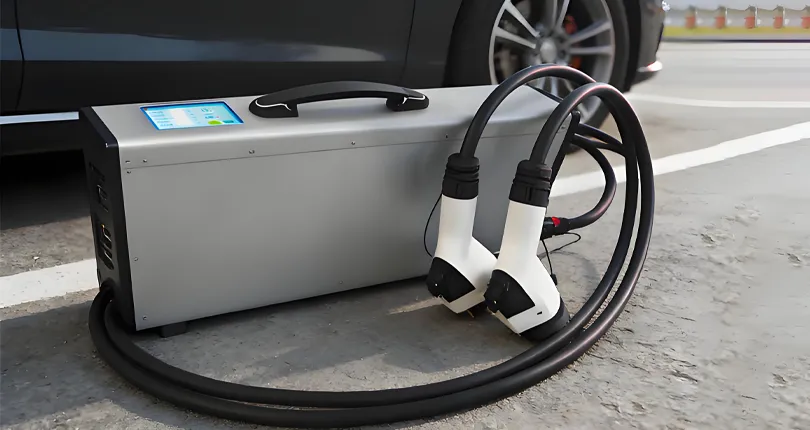
A 20kW charger built for V2V charging is designed to move power from a mobile energy source or one vehicle-based source to another EV in need of energy. In practical terms, v2v is essentially a way to send usable power from one battery-backed source to another vehicle without relying only on public or fixed charging stations. TREASURE presents its 20kW product as a compact and portable V2V charging device for bidirectional EV support, which matches the broader market direction for mobile rescue and flexible field charging.
The working logic is simple. The unit acts as a DC charger interface, manages power conversion and communication, and then delivers controlled output through the proper charging cable and charging gun. U.S. DOE and AFDC materials note that DC charging sends DC power directly to the battery, which is why it supports faster charging than basic AC methods.
For commercial readers, the key point is not theory. It is usability. A 20kw v2v ev charger helps you place charging where the vehicle is, rather than forcing the vehicle to find a fixed ev charging station. That difference is exactly why B2B users see value in mobile charging for service, rescue, depot overflow, and remote jobsites.

Why Is V2V Becoming More Important Than Fixed Charging Stations Alone?
Public and private charging stations are growing, but they still do not solve every problem. A vehicle may be stranded in a parking structure, a logistics yard, a port, an airport service lane, or a remote work zone. In those cases, fixed infrastructure is useful only if the vehicle can reach it. V2V changes that logic by taking power to the vehicle instead.
This is why the integration of v2v into broader charging infrastructure is getting more attention. DOE notes that bidirectional EV capability can add resilience and mobile storage value when paired with compatible equipment. That makes v2v technology relevant not only for emergencies but also for planned commercial operations.
From a project view, the benefit is obvious. You can reduce the need for every charging event to depend on fixed dc charging station assets. In some use cases, that can lower the pressure for immediate investment in additional grid charging infrastructure. The concept is not that V2V replaces all fixed chargers. It is that V2V fills the gaps that fixed chargers cannot cover well.
What Makes a Portable EV Charging Solution Valuable for B2B Users?
A portable charging product has real value when downtime costs money. That is especially true for factories, warehouses, fleets, municipalities, ports, and engineering contractors. These users care about response speed, safety, and service continuity more than consumer-style convenience. A portable ev charger answers that need by giving teams a movable backup power supply.
In real-world terms, a portable ev charging station can support:
- roadside rescue
- depot overflow
- temporary site charging
- event support
- service fleet backup
- remote project operations
That is why a charger portable format is often more useful than it first appears. It gives one team a mobile asset that can help more than one vehicle in more than one location.
How Fast Is a 20kW Unit in Real-World Fast Charging Scenarios?
A 20kW unit sits below high-power public DC hubs, but it still provides practical fast charging for rescue, transfer charging, managed topping-up, and field operations. DC fast charging equipment delivers DC power directly to the battery, and public DC systems span a wide range of output levels.
That means a 20kw portable unit is not trying to compete with every ultra-high-power highway charger. Its role is different. It is built for flexible dc charging, targeted recovery, and controlled support where mobility matters more than raw peak output. In short, it is efficient charging in the places where a fixed fast charging station is unavailable or impractical.
For B2B buyers, the key is matching the product to the job:
- emergency transfer charging
- light-to-medium duty fleet support
- temporary site deployment
- portable roadside assistance v2v ev
- mobile backup for electric vehicle charging
That is also why the market often discusses families such as 20kw 30kw or even 20kw 30kw 40kw products. Different projects need different output, weight, cooling, and duty-cycle balances.
What Technical Features Should Buyers Check Before Choosing a V2V EV Charger?
Start with connector compatibility. DC fast charging depends on compatible charge ports , depending on vehicle design and market. That means the first buying question is simple: does the ev charger type match your actual fleet or target vehicles?
Next, look at system architecture. A serious portable dc ev charger should offer stable DC output, thermal control, safe cable and plug design, clear HMI or interface logic, and communication protection. For B2B projects, the charging system also needs durable enclosures, fault alarms, and field-friendly serviceability.
Then review the working details:
- rated output and duty cycle
- portability and enclosure design
- cable length and charger cable
- connector and charging gun options
- battery-backed or external dc power support
- monitoring and service features
A buyer should also ask whether the unit is an advanced 20kw design meant for repeated commercial use or just light occasional usage. That difference shapes reliability, mobility, and lifecycle value.
How Does a DC Charger Station Compare With Traditional Public Chargers?
A fixed public charger station is excellent when access is easy, the vehicle can drive there, and the charging queue is manageable. DOE guidance on public charging shows the normal workflow: find a station, confirm connectors, connect, start the session, and monitor it.
A portable dc ev charger solves a different problem. It supports the vehicle where it sits. That makes it useful when:
- the EV cannot reach a fixed charger
- the route is time-sensitive
- the site is temporary
- the operator wants a charging station portable model
- the user wants less dependence on fixed charging stations
This difference is why a dc charger for V2V is not just another wallbox. A wallbox ev charging station belongs to a fixed infrastructure model. A vehicle-to-vehicle charger belongs to a mobile response model. Both matter. They simply answer different business needs.
Is a 20kW V2V Product the Right Fit for Your Project in 2026?
A 20kw v2v product is a smart fit when your project values flexibility, response speed, and field deployment. It is especially useful if your vehicles operate across large sites, urban rescue zones, remote areas, or temporary service points. In those cases, a portable electric charging option can solve problems that fixed assets cannot solve fast enough.
It is also a strong fit when your business wants to reduce the need for additional grid charging in the short term while still improving service readiness. That does not remove the role of permanent sites. It simply gives you another layer of resilience and mobile support while your EV operation grows.
A simple buying checklist looks like this:
- Do you need a portable or fixed solution?
- Will you support rescue, fleet, or temporary project use?
- Do your vehicles need DC transfer charging compatibility?
- Do you want a home portable ev style unit, or a true commercial product?
- Does your team need a charger dual use case with broader mobile power support?
- Are you planning around one vehicle to share power with another ev in controlled service scenarios?
If those questions sound familiar, a 20kw v2v dc product may be exactly the practical tool your team needs in 2026.
What is a 20kW V2V charger?
A 20kW V2V charger is a mobile DC charging device that transfers power from a mobile energy source or vehicle-based source to another EV. It is designed for flexible deployment, rescue, and commercial support scenarios.
Is V2V charging faster than AC charging?
In many cases, yes. DC charging delivers power directly to the battery, which is why it can charge faster than basic AC charging methods. Actual speed depends on the vehicle, connector, battery condition, and system settings.
Can a portable V2V charger replace fixed charging stations?
No. It is better viewed as a flexible supplement to fixed charging stations, not a total replacement. It is most valuable for emergency, mobile, remote, and temporary charging needs.
Who should buy a portable V2V EV charger?
Typical buyers include fleet operators, roadside assistance providers, logistics parks, municipalities, airports, ports, engineering contractors, and EV service companies that need fast field support.
What should I check before buying?
Check connector compatibility, output rating, portability, safety design, cooling, cable configuration, service support, and whether the unit is built for repeated commercial operation.
Why is 2026 a good time to consider mobile EV charging?
Because EV adoption is growing, but fixed infrastructure still cannot cover every scenario. Mobile and bidirectional charging add resilience, service flexibility, and faster response where static infrastructure falls short.

 Mobile EV Charging Robots
 Vehicle-Mounted Emergency Power Supply
 Energy Storage Systems
 EV DC Chargers Catalog
 V2V DC Charging Equipment