EV downtime is expensive. When drivers wait, routes slip, customers complain, and your fleet loses useful working hours. A mobile EV charging model solves this by bringing power to vehicles, depots, parking sites, and emergency locations instead of forcing every vehicle to find a charger.
A mobile EV charging station is a portable, battery-powered or vehicle-mounted charging solution that delivers EV charging service on demand. It supports fleets, commercial parking areas, roadside rescue, and off-grid EV charging where fixed charging stations are limited, delayed, overloaded, or too costly to install immediately.
What Is a Mobile EV Charging Station?
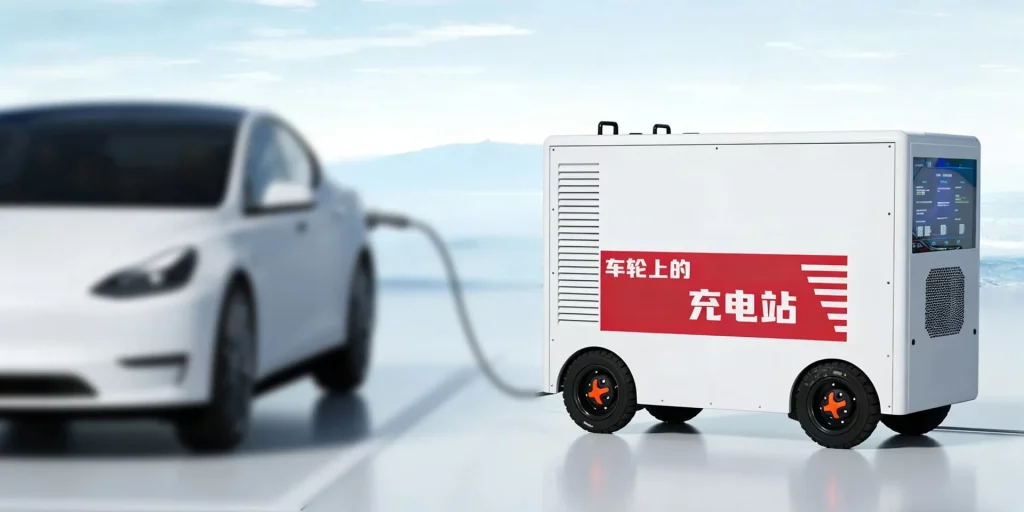
A mobile EV charging station is a movable charging solution that can deliver power directly to an electric vehicle without depending on a permanent site installation. It may be built as a mobile charging robot, vehicle-mounted emergency power unit, trailer-mounted charger, or battery-powered cabinet with charging guns.
In simple terms, it works like a portable energy station. Instead of asking EV owners, drivers, or fleet teams to search for the nearest charging station, the system moves power closer to the vehicle. This is useful for depots, warehouses, temporary events, construction areas, parking lots, logistics yards, and roadside support.
The global need is clear. The IEA reports that public charging points may exceed 15 million by 2030, up from almost 4 million in 2023, which shows how fast the EV charging network must expand to match adoption. Yet fixed infrastructure takes time, permits, grid upgrades, and capital. That gap creates space for flexible mobile EV charging solutions.
Why Is Mobile EV Charging Becoming Important for Fleet Operations?
For a private driver, charging is often a matter of convenience. For a fleet, it is an operating cost. A delivery van that cannot leave the depot is not just “low on battery.” It is a missed route, a delayed order, and a labor scheduling problem.
This is why mobile charging is gaining attention among logistics companies, parking operators, rental fleets, service vehicles, and commercial property managers. A portable charging solution can support vehicles during peak hours, cover unexpected energy gaps, and reduce pressure on fixed chargers.
The IEA also notes that public charger deployment should be coordinated with grid planning, because unmanaged charging can increase peak demand and stress local distribution systems. Mobile systems with battery storage can help smooth this problem by charging from the grid at one time and serving vehicles at another.
Main fleet pain points mobile charging can solve:
- Vehicles queue at fixed charging stations.
- Grid connection approval takes too long.
- Depot space is limited.
- Temporary projects need fast deployment.
- Drivers need emergency roadside charging.
- Fleet managers need backup during charger failure.
- Commercial sites want scalable charging before building permanent infrastructure.
For fleet charging, flexibility is often as valuable as power. A fixed charger stays where it is. A mobile unit goes where demand appears.
Mobile EV Charging vs. Fixed Charging Stations: Which Is Better?
Fixed charging stations are essential. They provide daily, high-volume charging at depots, public parking areas, highways, offices, and commercial buildings. But they are not always enough.
A portable charging model works best when the site needs speed, flexibility, or backup. It does not replace every fixed charging station nearby. It fills the gaps that fixed infrastructure cannot solve quickly.
| Comparison Point |
Fixed Charging Stations |
Mobile Charging Units |
| Deployment Speed |
Slower due to permits, civil work, and grid connection |
Faster for temporary or flexible use |
| Location |
Permanent |
Moveable |
| Grid Demand |
May require major utility upgrades |
Can buffer energy through battery storage |
| Best Use |
Long-term public or depot charging |
Fleet backup, emergency support, events, off-grid EV charging |
| Expansion |
Requires more installed chargers |
Add or dispatch more mobile chargers |
| Business Model |
Station-based charging |
On-demand mobile EV charging services |
For many B2B buyers, the right answer is not one or the other. A stronger plan combines fixed charging infrastructure with mobile backup. That way, daily operations stay stable, while urgent needs still receive charging support.
The U.S. Department of Transportation notes that DC fast charging can charge a battery electric vehicle to 80% in about 20 minutes to 1 hour, while Level 2 charging takes several hours. This explains why commercial operators often compare DC systems first when uptime matters.

Where Can a Mobile EV Charging Service Create the Most Value?
A mobile EV charging service creates the most value in places where demand changes by time, route, season, or project. Fixed stations are good for stable daily use. Mobile charging is better when the question is: “Where will the next charging need appear?”
Common B2B use cases include:
EV fleet depots
An electric vehicle fleet may have 20, 50, or 200 vehicles returning at similar times. If every vehicle needs power at once, the depot may face queues. A mobile unit can support overflow charging, backup routes, or vehicles that missed scheduled charging.
Commercial parking facilities
Shopping centers, airports, hotels, office parks, and paid parking sites may want EV charging service across several zones without installing chargers in every parking row. Mobile systems allow operators to test demand before making permanent investment.
Logistics and warehouse yards
Warehouses often run vans, forklifts, yard trucks, service vehicles, and delivery fleets. A portable charging solution can serve different vehicle groups across a large site.
Temporary events and construction sites
A fixed charger is not practical for a short-term exhibition, sports event, emergency project, or remote worksite. Portable EV charging can support temporary power needs without permanent installation.
Roadside support
A driver with a dead EV battery does not always need a tow. Sometimes the faster answer is emergency EV charging that gives enough range to reach the next safe location.
For operators that manage multiple service zones, mobile EV charging trucks across a city or region can build a flexible charging network without waiting for every location to complete construction.
Can Mobile Charging Support Emergency EV Charging and Roadside Rescue?
Yes. Emergency EV charging is one of the strongest use cases for portable systems. A roadside service provider, insurance partner, fleet maintenance team, or city operator can use a vehicle-mounted emergency power supply to deliver urgent charging directly to a stranded EV.
This is where phrases like emergency mobile electric vehicle charging, on-site urgent electric vehicle mobile support, and urgent electric vehicle mobile charging become real operational needs. When a driver searches “EV charging near me” and no charger is close enough, mobile support can prevent towing.
A practical emergency roadside workflow may look like this:
- Driver reports low battery or battery depletion.
- Dispatch team confirms location and vehicle connector type.
- Mobile EV technician receives the job.
- EV technician team arrives with a portable unit.
- The system provides enough energy for the driver to reach safety or a charging station.
- The service record is uploaded for billing and fleet reporting.
This is valuable for roadside service companies, EV rental operators, taxi platforms, delivery fleets, and large campuses. In these cases, reliable mobile EV charging assistance is not a luxury. It is a service continuity tool.
A good emergency system should include short-circuit protection, over-temperature protection, overcharge protection, connector compatibility, clear operating procedures, and remote monitoring. Safety matters more than speed when people and vehicles are on the road.

How Does TREASURE Build Turnkey Mobile EV Charging Solutions?
TREASURE works as a global B2B manufacturer specializing in commercial and industrial energy storage systems and EV charging solutions. Its product scope includes mobile charging robots, portable DC fast chargers, vehicle-mounted emergency power units, V2V charging equipment, battery packs, BMS/EMS management, and deployment support.
From our project experience, B2B buyers rarely ask only for a product. They ask for a working system. A factory may need solar plus storage system support. A parking operator may need a branded mobile charging service. A fleet operator may need reliable charging, emergency backup, and remote data. A system integrator may need OEM/ODM customization.
TREASURE’s turnkey approach can include:
- Battery pack configuration.
- DC charger module selection.
- Connector and cable matching.
- BMS/EMS integration.
- Cloud monitoring options.
- Branding, logo, color, and UI customization.
- Packaging and documentation support.
- Training and commissioning guidance.
- Charging solutions designed for fleet, depot, parking, or emergency use.
This makes the system suitable for factories, warehouses, commercial buildings, EV fleets, parking facilities, and microgrid projects. It also supports buyers who need mobile EV solutions before investing in a larger fixed network.
For OEM partners, customization is often the main reason to choose a manufacturer instead of a simple reseller. The product must fit local connector rules, service model, branding, language, climate, and charging behavior.
FAQs
What is a mobile EV charging station?
A mobile EV charging station is a portable or vehicle-mounted system that delivers power directly to an electric vehicle. It can support fleets, parking lots, emergency roadside service, events, and off-grid EV charging where fixed charging stations are not available or not enough.
Is mobile EV charging suitable for fleets?
Yes. It is especially useful for fleet charging when vehicles return at different battery levels, fixed chargers are busy, or the depot needs backup. It can also support electric vehicle fleet expansion before permanent infrastructure is ready.
Can a mobile EV charger replace fixed charging stations?
Usually, it works best as a complement. Fixed charging stations are good for stable daily demand. A mobile EV charger is better for flexible, temporary, emergency, or overflow charging needs.
What is the difference between portable charging and mobile charging?
Portable charging usually means a movable charger or compact DC unit. Mobile charging often means a full service model or larger system that can move to the vehicle, such as a mobile charging robot, truck-mounted unit, or battery-powered mobile charger.
Can mobile charging help with a dead EV battery?
Yes. Emergency EV charging can provide enough power for a vehicle with a dead EV battery to reach a safe location or the nearest charging station. This is useful for roadside service, rental fleets, and commercial operators.
What should I ask before buying a mobile EV charging system?
Ask about battery capacity, output power, connector type, voltage range, BMS safety, EMS monitoring, IP rating, operating temperature, customization, documentation, and after-sales support. For B2B projects, also ask whether the supplier can provide a complete charging solution, not only hardware.

 Mobile EV Charging Robots
 Vehicle-Mounted Emergency Power Supply
 Energy Storage Systems
 EV DC Chargers Catalog
 V2V DC Charging Equipment