An EV can lose power in the wrong place, at the wrong time. For fleets, one low-battery vehicle can delay routes, service calls, and deliveries. A 20kW V2V charging equipment solution helps solve this by moving power from one vehicle to another EV when fixed charging is not nearby.
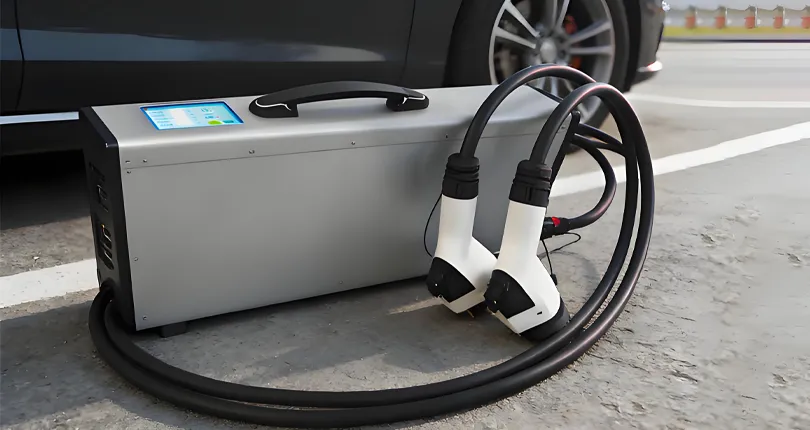
20kW V2V charging equipment is a portable vehicle-to-vehicle EV charger that transfers DC power from a power vehicle, battery system, or service unit to another EV. It is used for emergency charging, roadside assistance, mobile EV charging, fleet backup, and remote-area support when a fixed EV charging station is not available.
What Is 20kW V2V Charging Equipment?
20kW V2V charging equipment is a mobile EV charger designed to move energy from one vehicle or power source to another EV. V2V means vehicle to vehicle. In simple words, one vehicle becomes the power supply, and another electric vehicle receives the charge. This is useful when an EV cannot reach a charging station.
Unlike a common car charger or level 2 EV charger, a 20kW V2V EV charger usually provides DC power. This means the charger can send power more directly to the EV battery through a suitable connector. It is not meant to fully replace a large fast charging station, but it gives strong emergency and mobile charging support.
For B2B users, this charger is not just an accessory. It is a business tool. Roadside assistance teams, fleet operators, parking service providers, rescue vehicles, and new energy vehicle service companies can use it to provide reliable charging when fixed charging infrastructure is limited.

Why Does V2V Charging Matter for EV Roadside Assistance?
EV adoption is growing, but charging coverage is still uneven in many places. Some areas have enough public charging. Some do not. Some public chargers are busy. Some are too far away. For a driver, that means stress. For a fleet manager, it means downtime. For a roadside assistance company, it means a new service opportunity.
A portable roadside assistance V2V EV charger helps service teams bring energy to the vehicle instead of towing the vehicle to an EV charging station. This can reduce rescue time, improve customer satisfaction, and create a more professional emergency service model.
For example, when an electric car stops in a parking lot, highway service area, industrial park, or remote area, a service vehicle with V2V charging equipment can arrive and provide emergency charging. The goal is not always to fully charge the EV. Often, the goal is to add enough power so the driver can reach the nearest charging station safely.
How Does a 20kW V2V EV Charger Work?
A 20kW V2V EV charger works by taking energy from a source vehicle, onboard battery pack, or mobile DC power system and sending controlled DC power to another EV. The charger manages voltage, current, charging communication, and safety protection during the whole process.
The process is easy to understand:
- The service vehicle reaches the EV.
- The operator checks the EV model and connector.
- The charging cable connects the charger to the EV.
- The system confirms communication and safety.
- The charger starts DC charging.
- The EV receives power until it reaches the needed battery level.
- The operator stops charging and records the service result.
A good dc ev charger should not only deliver power. It should protect the operator, the vehicle, and the ev battery. That is why TREASURE designs charging equipment with BMS, EMS, safety control, and clear operation logic for business users.
Where Can a Portable EV Charging Station V2V System Be Used?
A portable EV charging station V2V system can be used in many B2B scenarios. It is especially helpful where fixed charging infrastructure is not ready, not close, or not enough for real demand.
Roadside service companies can use it for emergency charging. Fleet operators can use it when one vehicle returns with low battery and needs quick support. Parking operators can use mobile charging to help customers without building a charging pile at every parking space. Industrial sites can use it for backup power support for electric service vehicles.
For TREASURE, these use cases are very important. We do not view V2V technology as a small niche product. We see it as part of a wider mobile charging system that includes portable DC fast chargers, mobile charging robots, vehicle-mounted emergency power units, and energy storage solutions.
What Connector Options Matter: CCS2, NACS, CHAdeMO, and GB/T?
Connector choice is critical. A charger can have good power, but if the connector does not fit the EV, it cannot charge the vehicle. For global B2B projects, buyers should check the target market and EV models before selecting the charger.
Common connector options include CCS2, NACS, CHAdeMO, and GB/T. In Europe and many international markets, CCS2 is widely used. In Japan, CHAdeMO is still relevant for certain vehicle models. In North America, NACS is growing quickly because it is linked with Tesla-style charging. In China and some export markets, GB/T is common.
TREASURE can support connector planning based on the customer’s market. For some projects, buyers may request CCS2 GB/T CHAdeMO options. For other projects, they may need CCS2 NACS CHAdeMO compatibility. The right setup depends on the vehicles you plan to serve.
Connector Planning Checklist
- Target country or region
- Main EV brands and models
- CCS2, CHAdeMO, NACS, or GB/T requirement
- Cable length and charging cable handling
- Adapter policy and safety limits
- Vehicle voltage range
- Communication protocol
- Outdoor working conditions
- Emergency service workflow
If your service team works with many EVs, connector flexibility can become a major selling point.
How Can BMS and EMS Improve V2V Charging Safety?
A V2V charger must do more than move electricity. It must control electricity safely. This is where BMS and EMS matter. BMS means battery management system. EMS means energy management system. Together, they help manage power, monitor the system, and protect the EV charger during operation.
BMS helps monitor battery voltage, current, temperature, and state of charge. EMS helps manage power flow, charging strategy, and energy use. In a mobile charging system, this is important because the power source may be a service vehicle, battery pack, or mobile dc power supply.
A smart charger can support efficient charging and reliable charging by watching system data in real time. It can stop charging when a fault appears. It can help protect long-term battery health. It can also give operators better information about charging time, charging status, and power delivery.
Simple Safety Logic
- Check connector status.
- Confirm EV communication.
- Check voltage and current range.
- Monitor temperature.
- Control dc power output.
- Stop charging if unsafe data appears.
- Record system data for service review.
For commercial EV operators, safety is not optional. It is part of the business model.
Why Choose TREASURE for 20kW V2V Charging Equipment?
TREASURE is a global B2B manufacturer specializing in commercial and industrial energy storage systems and EV charging solutions. Our product range includes mobile charging robots, portable DC fast chargers, vehicle-mounted emergency power units, and V2V charging equipment. We also provide battery packs, BMS/EMS management, and turnkey deployment support.
For a China 20kW V2V charging equipment project, many buyers need more than a standard product. They may need custom connector options, private-label design, different power levels, language settings, software integration, or fleet service support. TREASURE can help design a solution around the real project.
We serve industrial operators, commercial facility managers, fleet operators, system integrators, parking service providers, and OEM partners. These customers care about stable performance, safety compliance, fast deployment, and long-term system management. That is exactly where our integrated product approach helps.
TREASURE Solution Advantages
- Custom power options: 20kW, 30kW, 40kW, and project-based configurations
- Connector flexibility: CCS2, NACS, CHAdeMO, GB/T, and regional planning
- Integrated design: Charger, battery pack, BMS, EMS, and software support
- Emergency focus: Suitable for roadside assistance and mobile EV service
- B2B customization: OEM branding, enclosure design, interface language, and system integration
- Deployment support: Guidance for fleets, factories, parking sites, and rescue service teams
A charger vehicle to vehicle system should be easy to operate, safe to deploy, and ready for real field conditions. TREASURE builds with that goal.
What Is the Future of 20kW V2V and Mobile Charging?
The future of EV charging will include more than fixed charging piles. Public charging stations, depot chargers, home chargers, mobile EV charging, and V2V charging station solutions will all work together. As EVs grow in commercial use, flexible charging will become more important.
The integration of V2V technology with energy storage and fleet platforms can create new service models. A mobile service vehicle may provide emergency charging. A parking operator may offer on-demand charging. A fleet manager may use mobile DC backup to prevent route delays. A system integrator may combine V2V charging with microgrid energy storage.
In short, V2V charging is not only about one EV helping another EV. It is about building a smarter and more flexible EV charging solution for a changing market.
FAQs
What is 20kW V2V charging equipment used for?
20kW V2V charging equipment is used to transfer power from one vehicle or mobile power source to another EV. It is mainly used for emergency charging, roadside assistance, fleet backup, remote areas, and mobile EV charging services.
Is a 20kW V2V charger a fast charger?
Yes, it can be considered a fast EV charger for mobile and emergency use, especially compared with many AC chargers. However, it is not as powerful as large public dc fast charging stations. Its strength is mobility and fast response.
Can a 20kW V2V EV charger fully charge an electric car?
It can charge an electric car, but emergency use usually focuses on adding enough range to reach a nearby charging station. Full charging depends on battery size, starting battery level, power output, and charging time.
Is V2V charging safe for the EV battery?
V2V charging can be safe when the charger uses proper communication, voltage control, current control, BMS, EMS, and protection design. A well-designed dc ev charger helps protect the EV battery and charging system.
Who should buy 20kW V2V charging equipment?
Roadside assistance companies, EV fleet operators, parking facility managers, commercial EV service providers, OEM partners, and system integrators can benefit from 20kW V2V charging equipment.
Conclusion: Build a More Flexible EV Charging Service With 20kW V2V Charging
A 20kW V2V charging equipment system gives businesses a practical way to support EVs beyond fixed charging infrastructure. It helps service teams provide emergency roadside assistance, supports fleets during low-battery situations, and gives commercial operators more flexible charging solutions.
For many buyers, the main value is not only charging speed. It is mobility, safety, compatibility, and fast deployment. A 20kW V2V EV charger can help bring power to the vehicle when the vehicle cannot reach the charging station.
TREASURE provides integrated EV charging and BESS solutions for global B2B customers. From portable DC fast chargers and mobile charging robots to vehicle-mounted emergency power units and V2V charging equipment, we help customers build reliable, scalable, and project-ready charging systems.
If your business needs a practical mobile EV charging solution for emergency service, fleet backup, or commercial deployment, TREASURE can support your next project with customized engineering and turnkey delivery.

 Mobile EV Charging Robots
 Vehicle-Mounted Emergency Power Supply
 Energy Storage Systems
 EV DC Chargers Catalog
 V2V DC Charging Equipment