الشحن المتنقل للمركبات الكهربائية uses a battery-powered unit, recharged from the grid during off-peak hours, to deliver DC power to vehicles without a fixed connection point. It solves problems where permanent charging infrastructure is blocked by grid capacity, civil-works cost, or available space, rather than replacing stationary chargers outright.
What “Mobile EV Charging” Actually Covers
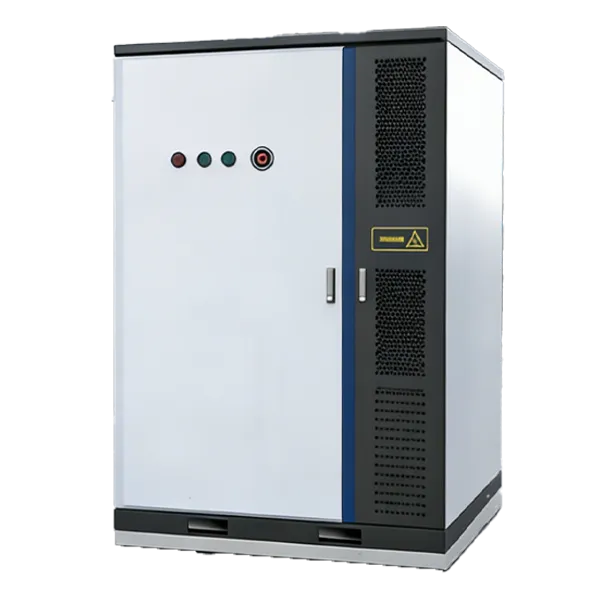
The term gets applied loosely online — sometimes to consumer-robot concept videos, sometimes to portable Level 2 cables, sometimes to full DC fast-charging trailers. For a charging operator or site manager, the useful definition is narrower: a self-contained battery energy storage unit with its own power electronics, charging output, and (in most commercial designs) an onboard HMI and BMS. It stores energy when the grid is idle and releases it to a vehicle when and where a fixed charger can’t reach.
That distinguishes it from two adjacent categories. A portable EV charger is typically just a cable and control box drawing power directly from an existing outlet or panel — it has no onboard battery, so it can’t operate independently of a live power source. A fixed DC fast charger, by contrast, is bolted to a foundation and wired to a permanent grid connection; it can deliver higher continuous power, but it can’t move.
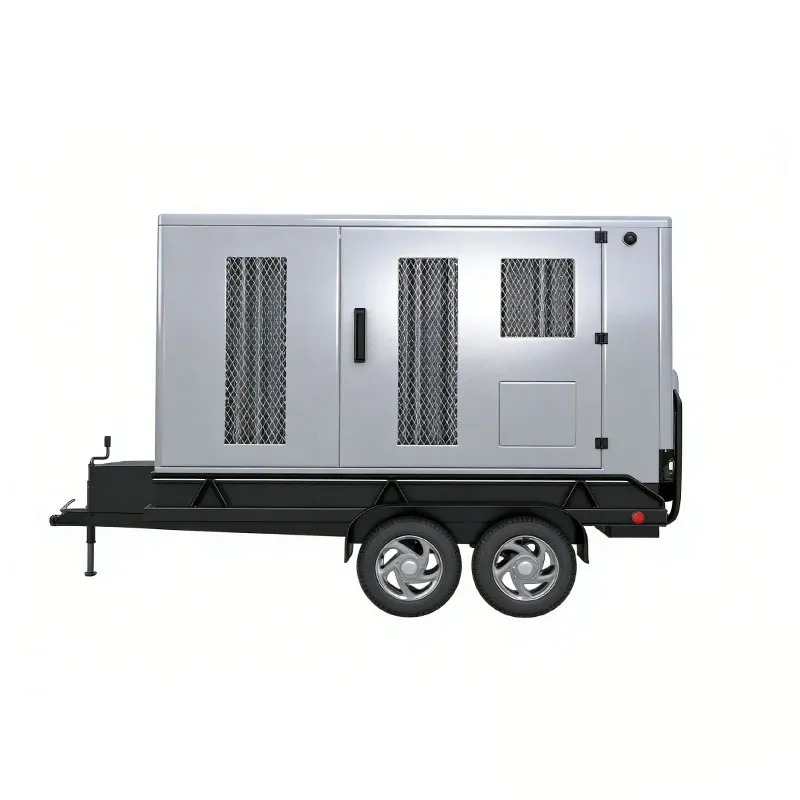
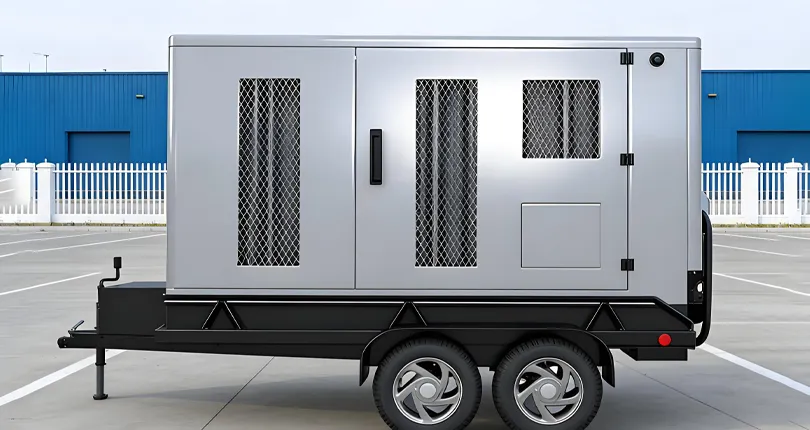
Mobile units sit between the two. They’re vehicles or transportable enclosures — commercial versions range from roughly 0.5 to 1.9 metric tons depending on battery capacity — built to be positioned wherever a charging need exists on a given day, then repositioned or returned to base once that need shifts.
How the Charging Cycle Works, Step by Step
The operating sequence is the same across most commercial mobile charging robots, though power ratings and connector options vary by model:
- Off-peak recharge. The unit’s internal battery pack — commonly lithium iron phosphate cells in current commercial designs — charges from a grid connection during low-tariff or low-demand hours.
- Deployment. The unit is moved to the location where charging demand exists: a parking area, a fleet depot, an event site, or a service station bay.
- Vehicle connection. An operator or driver connects using the supported interface — CCS and GB/T are the two most common on current models, alongside project-specific connectors for regional markets.
- Charging session. The onboard BMS regulates output at the unit’s rated power. Commercial mobile robots on the market today span roughly 40 kW to 120 kW depending on configuration, so session length depends heavily on which model is deployed.
- Monitoring. Where remote monitoring is configured, the operator can track state of charge, unit location, and fault status from a dispatch system rather than checking the unit physically.
- Return and recharge. Once its onboard capacity is drawn down, the unit returns to base to recharge, and the cycle repeats.
This is the operational trade-off in one sentence: a mobile unit trades unlimited grid-tied power for the ability to show up somewhere a cable trench can’t.
Why Operators Choose Mobile Units Over Fixed Infrastructure
Three site conditions come up repeatedly in procurement conversations, and none of them are really about charging speed.
The first is grid capacity. A site that can’t get an upgraded electrical service — or would face a long utility queue to get one — can still deploy a mobile unit, because the unit draws its recharge power gradually over off-peak hours rather than demanding a large instantaneous connection during the day.
The second is civil works. Trenching, conduit runs, foundations, and bollards for a fixed DC fast charger take weeks of permitting and construction. A mobile unit needs a parking space and, eventually, a recharge connection — not a construction project.
The third is temporary or shifting demand. Event parking, seasonal peaks, or a station testing whether charging demand justifies permanent infrastructure at all can use a mobile unit to serve the need without committing capital to a location that might not need it in six months.
Compared with typical fixed DC fast-charging installations, mobile units generally give up continuous high-power availability in exchange for site flexibility — that’s the trade a buyer is actually making, not “faster” versus “slower” charging.
Mobile Charging Robot Specifications Worth Checking Before You Buy
Specification sheets for mobile charging robots vary more between manufacturers than fixed chargers do, because the category spans everything from small single-vehicle units to multi-ton platforms. The table below reflects the configuration range currently published for TREASURE’s Mobile EV Charging Robot Series.
| سعة الطاقة |
طاقة الشحن |
Approx. Weight |
Connector Options |
| 55 kWh |
40 kW |
~0.5 t |
CCS, GB/T, project-configured |
| 100 kWh |
60 kW |
~0.9 t |
CCS, GB/T, project-configured |
| 150 kWh |
80 kW |
~1.45 t |
CCS, GB/T, project-configured |
| 200 kWh |
120 كيلو واط |
~1.9 t |
CCS, GB/T, project-configured |
The underlying battery specification across this series is 314 Ah cells at an operating voltage range of 525.6–700.8 V, with an integrated BMS, mobile chassis, HMI, and safety protection as standard, and remote monitoring available as an option. OEM and ODM configuration — branding, connector selection, and interface language — is available on a project basis.
One caveat worth flagging before you request a datasheet: capacity listings aren’t fully consistent across every page a manufacturer publishes. A dedicated product page might spotlight a 100 kWh configuration while a category listing leads with 55, 150, and 200 kWh options. That’s a reason to confirm the exact model lineup directly with the supplier before finalizing a spec, not evidence that the equipment itself is unreliable.
Certification is a separate question from specification, and it’s worth asking about directly. A supplier’s published capability list is not the same as a verified certificate — don’t take a product page’s claimed protection rating or safety compliance as confirmed until you’ve seen the actual certificate, its number, and the specific model it covers.
Mobile vs. Fixed Charging: Where Each One Wins
| Dimension |
Mobile Charging Unit |
Fixed DC Fast Charger |
| Installation lead time |
Days — no trenching for the base unit itself |
Weeks to months, including permitting and civil works |
| Grid capacity needed |
Gradual draw during off-peak recharge |
Continuous capacity at full rated power |
| Site flexibility |
Can relocate between sites |
Fixed to installed location |
| Upfront civil cost |
Lower — no foundation or trenching required |
Higher — trenching, foundation, bollards |
| Energy per session |
Bounded by onboard battery capacity |
Bounded mainly by grid connection and PCS rating |
| أفضل ملاءمة |
Space- or grid-constrained sites, temporary demand |
High-throughput corridor or hub locations with stable demand |
Neither column is the “better” option in isolation. A highway corridor charging hub with predictable, high daily throughput is usually a poor fit for mobile equipment — the onboard capacity limit means more units and more recharge cycles than a single well-sized fixed installation would need. A retrofit site with no available grid capacity is the opposite case.
One Misconception Worth Correcting
The most common misread of mobile EV charging, especially after consumer-robot coverage from automakers, is that it’s positioned to replace fixed fast-charging infrastructure altogether. It isn’t, at least not in current commercial deployments. A mobile unit’s total energy per deployment is fixed by its onboard battery — a 55 kWh unit delivers 55 kWh before it needs to return for a recharge cycle, regardless of how fast its output connector is rated.
That has a direct consequence for anyone estimating charging time from a spec sheet: how long a single vehicle actually takes to charge depends on the vehicle’s battery capacity, its starting state of charge, its charging curve, ambient temperature, and the unit’s rated output — not on the connector’s power rating alone. A supplier’s published charging-time figure for a specific pilot or site should be read as a result from that project’s conditions, not a guarantee that applies to every vehicle and every deployment.
The Trade-Offs Nobody Puts in the Brochure
الشحن عبر الهاتف المحمول has real advantages for site-constrained locations — no civil works, no long utility connection queue, and the ability to redeploy the same asset across sites as demand shifts. It also has costs that don’t show up until an operator is running the equipment day to day.
Capacity is finite per cycle. Unlike a grid-tied charger, a mobile unit can run out mid-shift. Fleet operators need a recharge and rotation schedule, not just a purchase order.
The hardware has real mass. A 1.9-ton unit needs a suitable tow vehicle or self-propelled chassis, parking clearance, and a driver or operator trained to position it — logistics that a bolted-down charger doesn’t require.
Certification data is often incomplete at the point of quote. As noted above, protection ratings and safety certifications should be confirmed with actual certificate documentation before a purchase decision, not assumed from a spec sheet or category page.
None of these are reasons to avoid mobile charging where the site conditions call for it. They’re reasons to ask a supplier for documentation, not just a brochure, before committing budget.

What to Ask a Supplier Before You Sign
For a charging operator evaluating vendors, a few questions do more work than a generic RFP:
- Which specific model and capacity is being quoted — not just the series name, since capacity, power, and weight vary substantially within a single product line.
- What connector and communication protocol the unit supports for your target market. CCS interoperability is documented by CharIN, the industry body that maintains the Combined Charging System standard; GB/T compliance should be confirmed against the specific standard edition relevant to your region.
- What the certificate documentation actually covers. IP protection ratings, for instance, are defined under IEC 60529 — but a rating on a product page should apply only to the exact configuration tested, not be assumed across an entire product family.
- What the vendor’s delivered track record looks like. Total capacity delivered and market reach are reasonable proxies for manufacturing maturity — TREASURE, for example, publicly reports more than 400 MWh of battery energy storage systems delivered across more than 10 countries — though that figure describes the company’s overall BESS business, not a specific mobile-charging deployment count.
- How pricing is actually structured. For most manufacturers, mobile charging equipment is quoted per project based on energy capacity, charging power, voltage architecture, connector standard, battery configuration, and software integration requirements — not off a public price list. Treat a supplier who gives a firm number without asking about your site conditions with some skepticism.
الأسئلة الشائعة
How much does a mobile EV charging robot cost?
Pricing is generally quoted per project, based on energy capacity, charging power, voltage architecture, connector standard, and software integration needs. A supplier that hasn’t asked about your site and fleet details before naming a number is likely giving a placeholder figure, not a real quote.
Can a mobile charging unit fully replace a fixed DC fast charger?
Not in current commercial deployments. Onboard battery capacity puts a hard limit on total energy delivered per cycle, which makes mobile units better suited to site-constrained or temporary-demand scenarios than to high-throughput corridor charging.
What connector standards do mobile EV charging robots support?
CCS and GB/T are the most common across current commercial models, with project-configured interfaces available for other regional standards. Confirm the specific connector and protocol with the supplier for your target market before ordering.
How long does it take to recharge the mobile unit itself?
This depends on the unit’s own battery capacity and the grid connection used for recharging, which varies by model and site — there isn’t a single figure that applies across the product category. Ask the supplier for the recharge time at your specific site’s grid connection.

 روبوتات شحن السيارات الكهربائية المتنقلة
 مصدر إمداد الطاقة في حالات الطوارئ المثبت على مركبة
 أنظمة تخزين الطاقة
 كتالوج شواحن التيار المستمر الكهربائية
 معدات الشحن بالتيار المستمر V2V