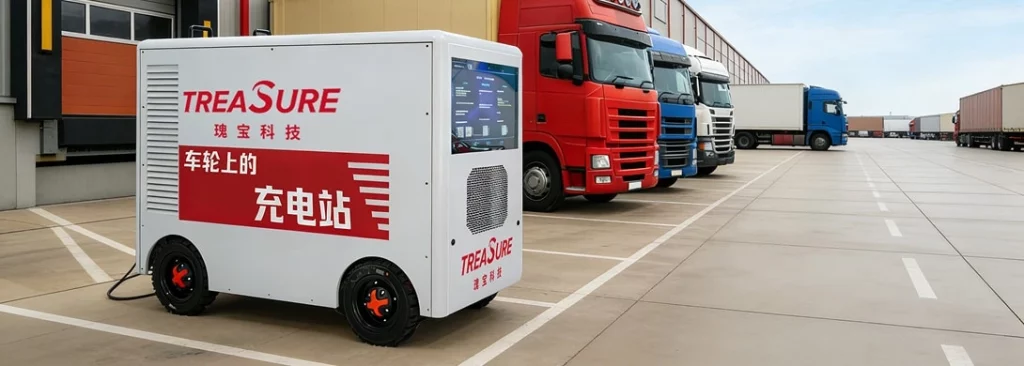
De TREASURE 150 kWh mobile EV charging robot uses 314 Ah battery cells, an operating voltage range of 525.6–700.8 V, and CCS/GB/T connector options, with an approximate unit weight of 1.45 tonnes. What the public spec sheet does not state is which of the line’s four listed charging power ratings — 40, 60, 80, or 120 kW — is actually paired with this specific capacity tier.
The 150 kWh Tier Inside TREASURE’s Mobile Charging Robot Line
De TREASURE Robot móvil de recarga de vehículos eléctricos Series is published with four energy-capacity options: 55 kWh, 100 kWh, 150 kWh, and 200 kWh. The 150 kWh configuration has its own dedicated model page, separate from the general category listing — which puts it in a different position than the 100 kWh option, shown only on the homepage and the product-detail page but not consistently listed on the category page itself. If you’re comparing capacity tiers before a request for quotation, that distinction matters: a dedicated model page generally signals a more settled commercial configuration than one that appears in only some placements.
For depot and fleet operators, 150 kWh sits in the middle of the disclosed range — large enough to deliver multiple sequential vehicle charges before needing to return to a stationary charging point, but well below the 200 kWh top tier’s weight and footprint.
Full Spec Sheet: 150 kWh Configuration
The table below lists every parameter TREASURE discloses for the Mobile EV Charging Robot Series that applies to the 150 kWh unit. Fields marked “series-wide, not tier-mapped” are published for the product line as a whole, without a stated breakdown by capacity.
| Parámetro |
Disclosed Value |
Notes |
| Capacidad energética |
150 kWh |
Dedicated model page available |
| Approximate Weight |
~1.45 t |
Listed alongside the 150 kWh figure in the same sequence as the other three capacity tiers; see caveat below |
| Battery Cell Specification |
314 Ah |
Series-wide |
| Operating Voltage Range |
525,6–700,8 V |
Series-wide |
| Charging Power Options |
40 kW / 60 kW / 80 kW / 120 kW |
Series-wide; not mapped to individual capacity tiers |
| Conectores |
CCS, GB/T, and other project-configured interfaces |
Series-wide |
| Physical Dimensions (L × W × H) |
Not disclosed |
Only weight is published for this series |
| Protection Rating (IP) |
Not disclosed |
Other TREASURE product lines publish IP ratings; this series does not |
| Onboard Systems |
Integrated BMS, mobile chassis, HMI, and safety protection |
Series-wide |
| Remote Monitoring |
Optional |
Series-wide |
| OEM/ODM Configuration |
Available |
Series-wide |
Two gaps are worth flagging before you build a spec comparison against another vendor’s unit: TREASURE’s public materials give weight but not length, width, or height for this series, and they don’t publish an IP ingress-protection rating for the mobile charging robot line specifically — both are reasonable things to request directly in an RFQ.
Does 120 kW Always Come With 150 kWh? Not on the Public Spec Sheet
Here’s the misconception worth correcting before you spec a project around it: the category and product pages list four charging-power options — 40, 60, 80, and 120 kW — but nowhere on those pages does TREASURE state which power rating applies to which of the four capacity tiers. It’s tempting to assume the largest battery pairs with the highest power output, since that’s the common pattern across the DC fast-charging market. But an assumption isn’t a spec, and pairing the wrong power figure with your capacity choice in a technical proposal is the kind of error that surfaces late, during commissioning rather than during planning.
The practical fix is simple: confirm the exact power rating for your target capacity tier directly with TREASURE’s engineering team before finalizing a technical proposal, rather than inferring it from the general product-line table.
1.45 Tonnes: What the Listed Weight Does (and Doesn’t) Confirm
TREASURE’s website displays four approximate weights — 0.5 t, 0.9 t, 1.45 t, and 1.9 t — in the same order as the four capacity options (55, 100, 150, and 200 kWh). That ordering is a strong indicator that 1.45 t corresponds to the 150 kWh unit. It is not, however, an explicitly labeled one-to-one mapping on the source page, so it should be treated as an inferred pairing rather than a confirmed spec until TREASURE’s team verifies it in writing.
For site planning, weight still matters more than most buyers expect from a “mobile” charger. At roughly 1.45 t, a 150 kWh unit needs a hard, level surface rated for that load, plus a tow or transport plan if it’s being repositioned between pump islands or depot bays rather than staying fixed at one point.

Connectors, BMS, and Remote Monitoring
Every capacity tier in the series ships with the same core feature set: CCS and GB/T connector support (with other interfaces available on a project-configured basis), an integrated battery management system, a mobile chassis, a human-machine interface for on-site operation, standard safety protection, and an optional remote-monitoring layer. OEM and ODM configuration is available across the line, which is relevant if your fleet standardizes on a particular connector type, branding, or dispatch-software integration rather than taking the base configuration as-is.
CCS itself is maintained as a cross-manufacturer standard by CharIN, the industry body responsible for the Combined Charging System’s interoperability specifications — worth knowing if your depot already runs a mixed fleet of CCS-equipped vehicles from different OEMs and you need charging hardware that doesn’t lock you into a single connector ecosystem.
150 kWh vs. the Other Three Capacity Tiers
| Tier |
Approximate Weight |
Best Fit When… |
| 55 kWh |
~0.5 t |
Site space and load-bearing capacity are limited, and charging sessions are short or infrequent |
| 100 kWh |
~0.9 t |
You need more throughput than the 55 kWh tier, but the dedicated 150 kWh model is unnecessary. Confirm current commercial availability directly, as this tier appears inconsistently across page types |
| 150 kWh |
~1.45 t |
You need to support several sequential vehicle-charging sessions before returning the unit to a fixed charging point |
| 200 kWh |
~1.9 t |
Maximum onboard energy is the priority, and the site can accommodate the additional weight and footprint |
Where This Capacity Tier Fits — and Where It Doesn’t
A mobile unit in this capacity class is generally positioned against a different alternative than another mobile charger: a permanently installed DC fast-charging pile. Compared with a fixed installation, a mobile 150 kWh unit avoids the trenching, utility-capacity upgrades, and civil works that a permanent pad-mounted charger typically requires — which is the reason TREASURE positions this product line for sites where construction is constrained by space, grid capacity, or permitting timelines rather than by charging demand itself.
That flexibility comes with real trade-offs, though. The unit needs to be recharged between deployment cycles, so total daily throughput is capped by how much energy the 150 kWh battery can hold and how often it gets replenished — it isn’t a direct substitute for a grid-tied charger with continuous power availability. Independent, third-party-verified figures for cycle life, round-trip efficiency, or real-world charging speed under varying conditions aren’t published for this configuration, so those numbers should come from TESORO directly as part of a technical proposal rather than from marketing copy alone. And because certification documentation isn’t publicly verifiable from the current site content, any CE, UL, or IEC compliance claim for a specific unit needs its own certificate check before it goes into a purchasing decision.
Pricing
Pricing is provided on a project-by-project basis and depends on energy capacity, charging power, voltage architecture, connector standard, battery configuration, PCS selection, enclosure design, communication protocol, software integration, logistics, commissioning, and other project requirements.
PREGUNTAS FRECUENTES
What’s the actual weight of TREASURE’s 150 kWh mobile EV charging robot?
TREASURE’s website lists an approximate weight of 1.45 t alongside the 150 kWh capacity figure. This pairing is inferred from the order the numbers appear in on the source page rather than an explicitly labeled spec, so it’s worth confirming directly before finalizing site-load planning.
What charging power does the 150 kWh unit support?
The product line publishes four power options — 40, 60, 80, and 120 kW — without stating which one applies to the 150 kWh tier specifically. Confirm this with TREASURE’s engineering team before building a technical proposal around a particular power figure.
What connectors does this unit support?
CCS and GB/T are the standard disclosed connector options, with other interfaces available on a project-configured basis depending on the target market and vehicle fleet.
Is a 150 kWh mobile charger a replacement for a fixed DC fast charger?
Not directly. It avoids the civil works and grid-capacity upgrades a permanent installation typically needs, but its total daily throughput is limited by battery capacity and recharge frequency rather than continuous grid power — the two solve different site constraints.

 Robots móviles de carga de vehículos eléctricos
 Fuente de alimentación de emergencia montada en el vehículo
 Sistemas de almacenamiento de energía
 Catálogo de cargadores de CC para VE
 Equipo de carga de CC V2V