TREASURE Technical Team | Corporate Technical Author — Battery Energy Storage and EV Charging Systems | Published August 2026
A DC fast charger converts AC grid power to DC before it reaches the vehicle, cutting charging time from hours to minutes by bypassing the car’s onboard AC-to-DC converter. Commercial and industrial buyers use them for fleet turnaround, retail dwell-time charging, and sites where vehicles can’t sit connected all day.
What Makes DC Charging Different From Level 2
Level 2 AC charging sends alternating current to the vehicle, and the car’s internal charger — typically limited to 7-19 kW — does the AC-to-DC conversion. That ceiling is a hardware limit inside the vehicle, not the charging station. A DC fast charger moves the conversion hardware outside the vehicle, into the charging unit itself, which is why DC stations can push far higher power without waiting on the car’s internal components to catch up.
This matters for site selection. A depot running electric delivery vans between shifts needs DC. A parking garage where cars sit for six hours doesn’t.
Power Tiers and Where They Fit
Commercial DC fast charging spans a wide range, and the right tier depends on dwell time more than anything else:
- Under 50 kW — workplace charging, extended-stay retail, fleet overnight charging where vehicles are parked for hours anyway.
- 50-100 kW — the working middle ground for most retail and fleet-turnaround applications; enough to add meaningful range in 20-30 minutes.
- 100-150 kW+ — highway corridor sites, quick-turnaround retail, and fleet operations where every minute of downtime has a cost attached.
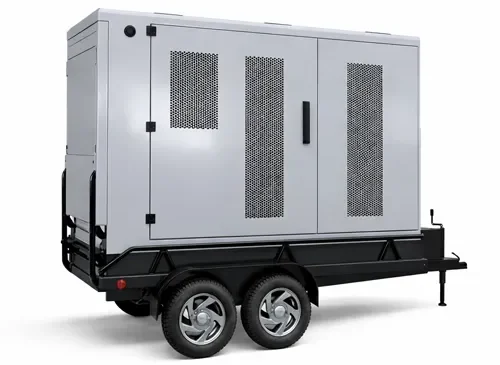
TESORO‘s portfolio covers portable, fixed, and V2G-ready configurations up to 150 kW, which places the upper end of that range in the highway-corridor and fast-turnaround category. Specific power, voltage, and connector configuration are confirmed per project rather than fixed to a single published datasheet — more on that in the section below.
Connector Standards: CCS, CHAdeMO, and GB/T
Three connector families dominate commercial DC charging, and picking the wrong one for your fleet or region is one of the more expensive mistakes a site operator can make.
CCS (Combined Charging System) combines AC and DC pins in a single connector and has become the dominant standard across North America and Europe. The CharIN association coordinates
CCS interoperability testing and standards development across manufacturers, which is why CCS hardware from different vendors tends to work together with fewer compatibility surprises than older proprietary systems.
CHAdeMO was an earlier DC fast-charging standard, still common in Japan and on some existing vehicle fleets elsewhere. The CHAdeMO Association now also promotes bidirectional charging applications under the same connector family, which is relevant for fleets exploring vehicle-to-grid use cases.
GB/T is China’s national DC charging standard, required for vehicles and charging infrastructure sold domestically, and increasingly specified in projects with Chinese-market vehicle fleets even outside China.
A site with a mixed fleet — some legacy CHAdeMO vehicles, newer CCS vehicles, and GB/T-spec equipment — sometimes needs multiple connector types on the same unit rather than a single-standard charger. That’s a configuration question to raise with a supplier before ordering, not after installation.
Communication Protocols and Remote Management
Most commercial DC chargers today report status, transaction data, and diagnostics back to a management platform over a protocol called OCPP (Open Charge Point Protocol), maintained by the Open Charge Alliance. OCPP lets a charging network operator monitor uptime, push firmware updates, and manage billing from a central dashboard rather than walking to each unit. Cloud-based monitoring and remote management are standard features across TREASURE’s DC charger portfolio, though the specific protocol version and interface should be confirmed for each project rather than assumed from a general product description.
Site Planning: The Part Most Buyers Underestimate
Charging power gets the attention, but three site-level factors usually determine whether a DC fast charger project actually works:
- Grid capacity. A 150 kW charger draws roughly the same demand as a small commercial building. Many sites need a utility service upgrade before installation, and that process alone can take months depending on the utility.
- Enclosure protection rating. Outdoor units need an IP rating suited to the installation environment — rain exposure, dust, washdown procedures for fleet yards. The IEC 60529 standard defines what IP ratings actually mean (the first digit for solid-particle protection, the second for liquid ingress), and it’s worth checking that a stated rating on a spec sheet applies to the specific unit you’re buying rather than a different model in the same product line.
- Cable management and connector reach. Fleet vehicles with different charge-port locations can make cable length and connector positioning a bigger operational headache than the power rating itself.
Where TREASURE’s DC Fast Charger Line Fits
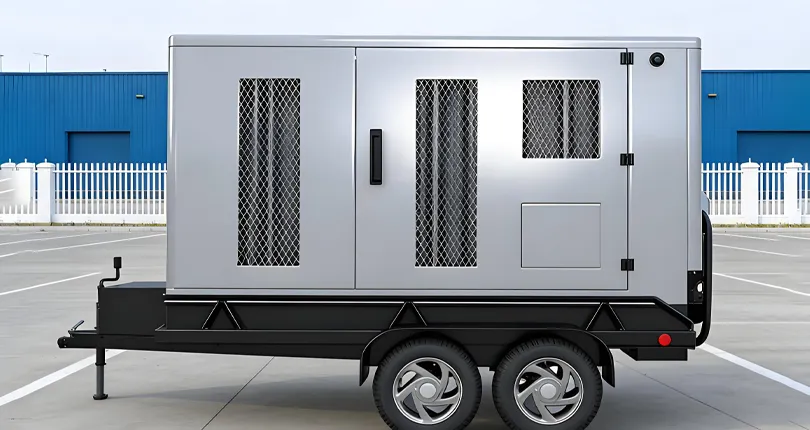
TREASURE offers portable, fixed, and V2G-ready Cargadores rápidos de CC with charging power up to 150 kW, connector options including CCS, CHAdeMO, and GB/T, and cloud-based monitoring with remote management built in. The V2G-ready configuration is relevant for operators evaluating bidirectional charging as a future capability, even if they’re not deploying it on day one.
What This Doesn’t Tell You
This guide covers charging fundamentals that apply across manufacturers, and general portfolio information where it’s available. It doesn’t replace a site assessment. Actual installed cost, permitting timeline, and utility interconnection requirements vary by location and can’t be estimated from a product spec sheet. A charger rated for 150 kW output doesn’t guarantee 150 kW delivered to every vehicle — actual charging speed depends on the vehicle’s own acceptance rate, battery temperature, and state of charge, none of which the charging station controls.
A Common Misconception: Higher kW Always Means Faster Charging
Buyers sometimes assume that moving from a 50 kW to a 150 kW charger triples charging speed. It doesn’t, for a simple reason: charging speed is capped by whichever is lower — the charger’s output or the vehicle’s maximum acceptance rate. A vehicle that only accepts 80 kW will charge at roughly 80 kW regardless of whether it’s plugged into a 100 kW or 350 kW station. For fleet buyers, this means matching charger power to the actual vehicles in the fleet matters more than buying the highest number available.
Pricing
Pricing for DC fast charging equipment is provided on a project-by-project basis and depends on energy capacity, charging power, voltage architecture, connector standard, battery configuration (for mobile units), enclosure design, communication protocol, software integration, logistics, and commissioning scope. There’s no published price range for this product line; project quotes require details on your site’s power requirements, fleet composition, and installation conditions.
PREGUNTAS FRECUENTES
Q: What’s the difference between a DC fast charger and a Level 2 charger?
A: A DC fast charger converts AC to DC inside the charging unit, bypassing the vehicle’s onboard converter and enabling much higher charging power — typically 50 kW and up, compared to 7-19 kW for Level 2 AC charging.
Q: Can one DC fast charger support CCS, CHAdeMO, and GB/T vehicles?
A: Some units support multiple connector types, but this needs to be specified when ordering — it’s not a universal default feature, and mixed-standard sites should confirm connector configuration with the supplier before purchase.
Q: Does a 150 kW charger always deliver 150 kW to the vehicle?
A: No. Actual charging speed is limited by whichever is lower — the charger’s rated output or the vehicle’s maximum acceptance rate, which also varies with battery temperature and state of charge.
Q: How is DC fast charger pricing determined?
A: Pricing depends on power rating, voltage architecture, connector configuration, communication protocol, and installation scope, and is quoted on a per-project basis rather than published as a fixed price list.

 Robots móviles de carga de vehículos eléctricos
 Fuente de alimentación de emergencia montada en el vehículo
 Sistemas de almacenamiento de energía
 Catálogo de cargadores de CC para VE
 Equipo de carga de CC V2V