Un EV charging robot is a battery-powered mobile unit that delivers DC charging without a fixed grid connection at the parking spot. For fleet and depot operators, it works as portable charging infrastructure — sized from tens to low hundreds of kilowatt-hours — not the autonomous service novelty most search results describe.
What “EV Charging Robot” Actually Means in a B2B Context
Search results for this term currently skew toward a specific storyline: a small robot that drives up to a parked car and plugs in autonomously, covered as a consumer convenience feature at malls or in pilot programs. That framing answers “can a robot find my car,” not “can this replace or supplement my charging infrastructure.”
For a fleet operator, a depot manager, or a site owner evaluating charging capacity, the relevant category is different. A mobile EV charging robot is a self-contained battery energy storage system built onto a wheeled or towable chassis, with an integrated battery management system (BMS), a human-machine interface (HMI), and DC output connectors. It stores energy during off-peak hours and discharges it to vehicles on demand, at a location that doesn’t require permanent electrical infrastructure.
The two use cases overlap in name only. One is a demonstration of automated parking-lot service. The other is a capital-equipment decision about where charging capacity should physically sit.
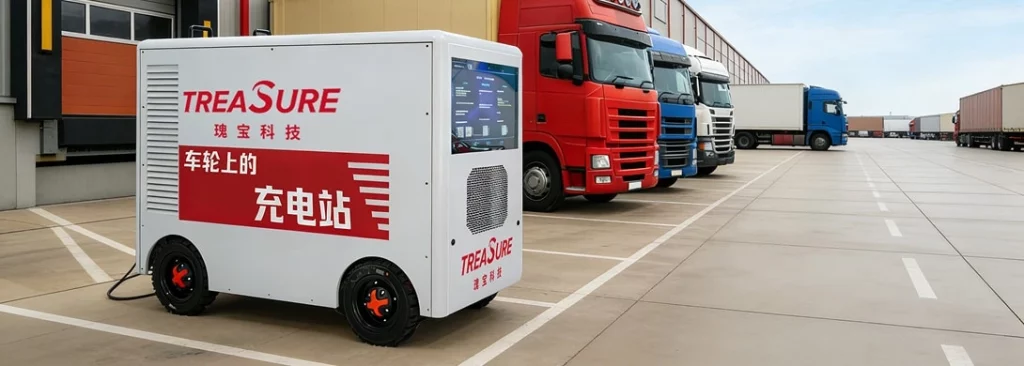
How It Differs From a Fixed DC Charging Pile
Compared with a conventional fixed-pile charging installation, a mobile charging robot shifts several project variables:
| Factor |
Fixed DC Charging Pile |
Robot di ricarica mobile |
| Site prep |
Trenching, civil works, permanent grid tie-in |
Minimal — unit is positioned and connected on-site |
| Deployment timeline |
Weeks to months, dependent on permitting |
Typically hours to days once the unit is on-site |
| Grid capacity dependency |
Requires continuous grid draw matching output power |
Charges from grid during off-peak hours, discharges independently |
| Relocation |
Not practical once installed |
Repositionable between sites or zones |
| La migliore vestibilità |
Stable, long-term demand at a fixed point |
Peak-shaving, temporary demand, space-constrained or grid-limited sites |
This isn’t a case where one option is strictly better. A site with predictable, high daily throughput and available grid capacity is usually still better served by fixed infrastructure, because a mobile unit’s total energy output per cycle is capped by its own battery size. Where a robot earns its cost is in queue-heavy periods, construction-phase sites without finished electrical work, or locations where civil works for a pile aren’t currently feasible.
Core Specifications to Check Before Evaluating One
TREASURE’s Mobile EV Charging Robot Series is offered across several configurations, and the published specification ranges are wide enough that buyers need to confirm the exact configuration against project requirements rather than assume a single fixed model:
| Parametro |
Disclosed Range |
| Capacità energetica |
55 kWh, 100 kWh, 150 kWh, 200 kWh |
| Potenza di ricarica |
40 kW, 60 kW, 80 kW, 120 kW |
| Specifiche delle celle della batteria |
314 Ah |
| Operating voltage |
525,6–700,8 V |
| Peso approssimativo |
0.5 t to 1.9 t, depending on capacity |
| Connettori |
CCS, GB/T, or project-configured interfaces |
| Core electronics |
Integrated BMS, mobile chassis, HMI, safety protection; remote monitoring optional |
| Configuration |
OEM/ODM available |
One edge case worth flagging directly: the 100 kWh configuration appears on the product-detail page and homepage, while the category listing page shows 55 kWh, 150 kWh, and 200 kWh as the primary lineup. That’s a real inconsistency in the current published material, not a typo to gloss over — buyers should request a confirmed model list and current datasheet before finalizing a specific capacity, rather than treating any single web page as the complete range.
Connector compatibility is a second area that gets skipped in general explainer content. CCS and GB/T are not interchangeable, and a unit configured for one market’s connector standard won’t serve a fleet running a different standard without a hardware change. The Combined Charging System (CCS) architecture and its interoperability requirements are documented by CharIN, the industry association managing the CCS standard — worth checking against before assuming any given unit covers a mixed fleet.
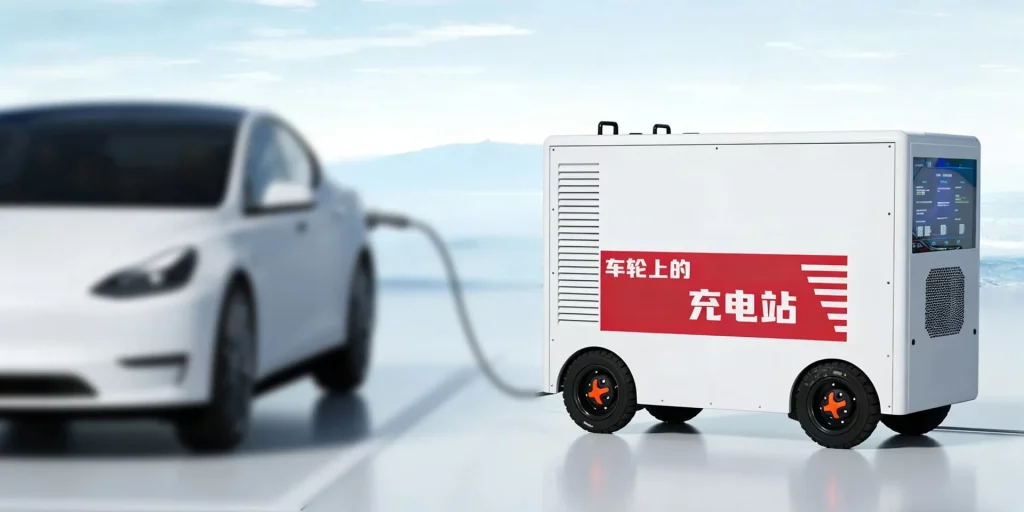
Who Deploys These, and Why
The buyers who actually evaluate this category tend to fall into a few groups:
Fleet operators running vehicles that return to a depot on a schedule use mobile units to add charging capacity during a grid-capacity upgrade, without waiting for permitting on a permanent installation. Fuel-retail and service-station operators use them to relieve queue pressure at existing pumps or bays during peak demand windows, without adding a second row of fixed piles. Construction and mining sites, where the electrical infrastructure is still being built out, use them as an interim charging solution that doesn’t depend on the site’s permanent grid connection being finished.
Across these groups, the buying question is rarely “is this better than a fixed pile.” It’s “does our peak demand, our space constraint, or our construction timeline make a mobile unit the more workable option for the next 12 to 24 months.”
What Mobile Charging Robots Cost
TREASURE does not publish fixed price lists for this product line. Final quotations depend on the selected energy capacity, rated power, voltage architecture, connector standard, BMS/EMS configuration, communication protocol, enclosure design, and whether OEM/ODM customization is required. Buyers requesting a quote should be prepared to share their application scenario, required power and energy capacity, fleet information, grid conditions, and project timeline so a technical proposal can be prepared against the actual site — not a generic list price.

Getting a Project Scoped
- Document peak charging demand at the site (vehicles per hour, dwell time, required charge rate).
- Confirm available grid capacity for off-peak recharging of the robot itself.
- Identify the connector standard(s) your fleet uses — CCS, GB/T, or mixed.
- Decide whether the unit needs to relocate between zones or stay fixed at one point.
- Request a configuration proposal against energy capacity, charging power, and connector requirements rather than a single “standard model.”
FAQ
Is an EV charging robot the same as a battery on wheels?
Functionally similar, but the distinction is the integrated BMS, HMI, and safety protection systems that manage charge/discharge cycles and connector output — not just battery cells in an enclosure.
Can one unit charge multiple vehicles at once?
This depends on the specific configuration and connector setup; it’s a question to confirm against the exact model rather than assume across the product line.
What’s the typical energy capacity range?
TREASURE’s published range spans 55 kWh to 200 kWh, with charging power options from 40 kW to 120 kW — the right size depends on daily throughput and dwell-time requirements at the site.
Does a mobile charging robot replace fixed charging infrastructure?
Not typically. It’s better suited to peak-shaving, temporary demand, and space- or grid-constrained sites, while stable high-throughput locations are usually still served better by fixed piles.
How is pricing determined?
Project-by-project, based on energy capacity, charging power, voltage architecture, connector standard, and configuration requirements — TREASURE does not publish a fixed price list for this category.

 Robot di ricarica mobile per veicoli elettrici
 Alimentazione di emergenza montata sul veicolo
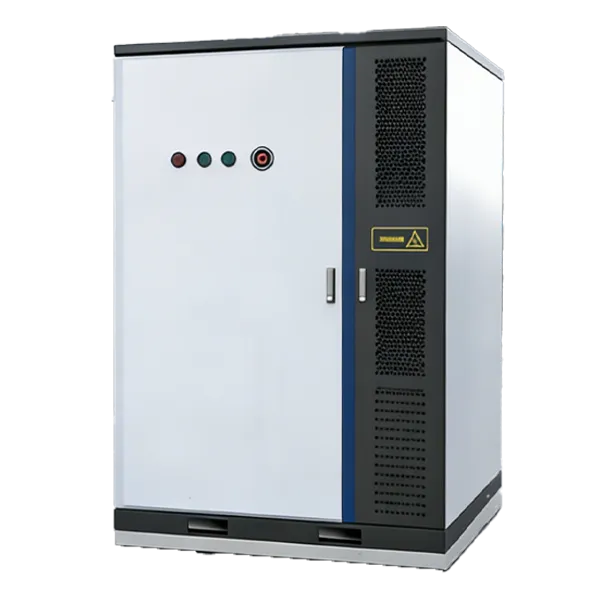 Sistemi di accumulo di energia
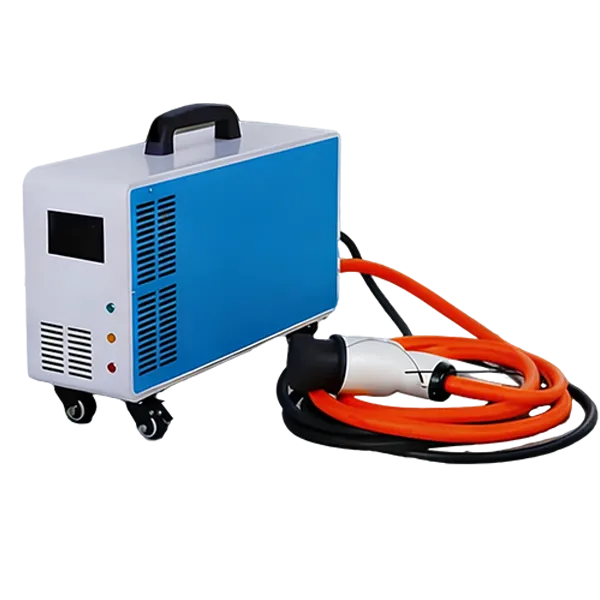 Catalogo dei caricatori EV DC
 Apparecchiature di ricarica V2V in corrente continua