EV drivers do not only need power at fixed stations. They need power when a car stops, a fleet delays, or a site lacks charging. A 20kw V2V charging station solves this pain by moving reliable charging closer to the electric vehicle.
20kw V2V charging equipment is a portable EV charger that supports vehicle-to-vehicle charging or mobile charging when fixed charging infrastructure is not available. It helps roadside service teams, fleet operators, parking facilities, and commercial users provide emergency charging, reduce downtime, and improve EV service flexibility.
What Is 20kw V2V Charging Equipment?
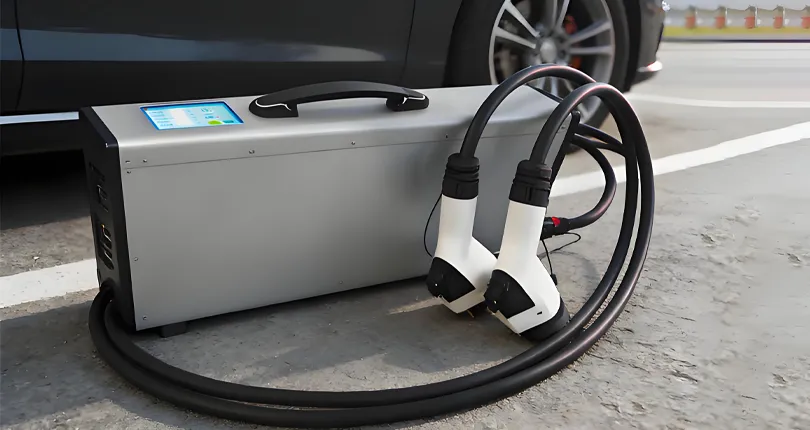
20kw V2V charging equipment is a portable DC charging system that allows one power source, service vehicle, or energy storage unit to charge another electric vehicle. In simple terms, it helps one vehicle to share battery power with another when the receiving EV needs energy. This is why many buyers search for a v2v ev charger, charger vehicle to vehicle, or vehicle-to-vehicle charging solution.
Unlike a normal home car charger, a 20kw V2V system is built for practical field use. It can serve as a portable ev charging station, an emergency unit, or a mobile charging tool for fleets, parking operators, and roadside service teams. The 20kw output power gives a useful balance between charging speed, equipment size, energy use, and mobility.
For B2B buyers, the value is clear. A 20kw portable V2V charger helps bring power to the electric car instead of forcing the vehicle to reach a fixed charging station. This matters when an EV has a low battery, when a customer needs rescue, or when a commercial site wants flexible charging without building a full electric vehicle charging station in every location.
Why Is V2V Charging Important for Emergency Roadside Assistance?
The biggest use case for V2V is emergency roadside assistance. When an EV runs out of power, towing is not always the best answer. A roadside operator can use a portable roadside assistance V2V EV system to deliver enough energy for the driver to reach a nearby charging station or return to service.
For roadside companies, rental fleets, logistics operators, and parking managers, emergency service is not only about power. It is about minimizing downtime. A fast response can turn a bad driver experience into a professional service moment. That is why a v2v charging station can become part of a modern EV service business.

How Does a Portable V2V EV Charger Work?
A portable V2V charger usually connects the power source to the receiving vehicle through a safe DC charging interface. The system controls voltage, current, communication, and safety protection during the charging process. In many practical designs, the charger takes DC power from a battery pack or service vehicle and delivers controlled dc power to the EV battery.
The process is simple for the operator:
- Move the portable unit or service vehicle near the electric vehicle.
- Connect the charging cable to the EV.
- Start the charging session through the control panel or system interface.
- Monitor voltage, current, temperature, and charging status.
- Stop charging safely when the EV has enough power.
A good charger 20kw system should not only push power. It should manage the whole charging process safely. This includes communication, insulation checks, temperature monitoring, fault alerts, and automatic shutdown when abnormal conditions occur.
What Safety Features Should a V2V Charger Have?
A professional V2V charger must be safe before it is fast. The system should include overcurrent protection, short-circuit prevention, insulation monitoring, emergency stop, thermal management, and clear fault reporting. These functions help protect the vehicle, the operator, and the charger.
For industrial and commercial buyers, safety is also a trust issue. If a roadside team uses a dc fast EV charger beside a customer’s car, the system must feel reliable. If a fleet uses it every day, it must survive repeated operation. A weak charger may save money at purchase but create higher risk later.
Important safety features include:
- Overcurrent protection to prevent excessive current
- Short-circuit protection and automatic shutdown
- Temperature monitoring for cables, connectors, and power modules
- Battery management system support
- Clear display and alarm information
- Safe connector locking
- Emergency stop button
- Strong cabinet design for outdoor or field conditions
At TREASURE, safety is part of the whole system. We focus on battery packs, BMS, EMS, energy storage control, and integrated EV charging solution design for long-term use.
How Can V2V Charging Reduce Charging Costs and Downtime?
Many companies look at V2V charging because it can reduce charging costs in indirect ways. It may reduce towing, lower rescue time, prevent missed deliveries, and help fleets avoid sending vehicles far away for charging. The direct electricity cost is only one part of the full cost picture.
For fleet operators, downtime is expensive. One stopped vehicle can delay goods, service teams, or customer orders. A portable fast EV charger can bring energy to the vehicle and help it return to work faster. This is why reliable charging matters more than a cheap device.
Here is a simple business case:
A fleet has several electric vans. One returns with a low battery, but all fixed chargers are occupied. A 20kw V2V unit provides backup charging for 30–60 minutes. The vehicle can continue a short route instead of waiting for a fixed charger.
This is not only emergency use. It is also operational flexibility. A well-planned integration of V2V can support daily fleet management, temporary peak demand, and mobile EV charging for special events.
How to Choose Between 20kw, 30kw, and 40kw Charging Solutions?
A 20kw charger is often the best choice when the buyer wants a compact, portable, and cost-controlled system. It is suitable for roadside support, fleet backup, parking service, and light commercial use. A 30kw 40kw system may be better when faster charging is required or when a site handles more vehicles per day.
The choice between 20kw 30kw 40kw should be based on:
- Average EV battery size
- Needed charging time
- Number of vehicles served per day
- Available power source
- Mobility requirements
- Cabinet size and weight
- Budget and return on investment
- Connector standards and local market needs
A 20kw V2V unit is often easier to move and deploy. A higher-power system may give better fast charging performance but may require stronger components, better cooling, and more energy supply. The right solution depends on your operating model, not just the number on the nameplate.
Why Choose TREASURE as Your V2V Charging Equipment Manufacturer?
TREASURE is a global B2B manufacturer specializing in commercial and industrial energy storage systems and EV charging solutions. Our product range includes mobile charging robots, portable DC fast chargers such as 7kW and 20kW units, vehicle-mounted emergency power units, V2V charging equipment, battery packs, BMS/EMS systems, and turnkey deployment support.
We serve factories, warehouses, commercial buildings, EV fleets, parking facilities, microgrid projects, system integrators, and OEM partners. These customers do not only ask for a charger. They need a complete charging solution that is reliable, safe, easy to deploy, and suitable for long-term operation.
TREASURE can support:
20kw V2V equipment configuration
Portable charger design and customization
Vehicle-mounted emergency charging systems
Battery and energy storage integration
Connector options for different markets
BMS/EMS management
Technical support for deployment
OEM and project-based customization
For overseas B2B buyers, our goal is simple: help you build a practical, safe, and profitable charging service. Whether you need a charger portable EV charging station, a vehicle EV charger, a portable V2V unit, or a customized v2v fast solution, TREASURE can help you move from idea to deployment.
How Does V2V Fit into the Future of EV Charging?
The future of EV charging will not depend on one type of charging station. It will include home charging, workplace charging, public fast charging, fleet charging, battery energy storage, bidirectional charging, and mobile charging. A portable V2V solution fits into this wider ecosystem.
Bidirectional charging and V2V technology show that EVs are becoming part of a larger energy network. Power can move between the grid, battery storage, vehicles, and mobile systems. For B2B buyers, this creates new business models in rescue service, fleet support, commercial parking, and temporary charging projects.
A fast EV charging station may still be the best choice for highway corridors. But a mobile EV or portable V2V charger is useful when flexibility matters. Together, these systems support a more complete EV charging solution.
FAQs About 20kw V2V Charging Equipment
What is 20kw V2V charging equipment?
20kw V2V charging equipment is a portable DC charger that can transfer power from a service vehicle, battery system, or other power source to an electric vehicle. It is used for emergency charging, fleet backup, and mobile EV charging.
Is a 20kw V2V charger fast enough for emergency use?
Yes. A 20kw charger can provide a useful energy boost in a short time. It may not replace a high-power public dc fast charger, but it is very useful for emergency rescue, roadside assistance, and backup charging.
Can this equipment work as a portable EV charging station?
Yes. A 20kw portable EV charging station can be used in parking facilities, fleet depots, dealerships, remote areas, and service vehicles. It helps operators provide charging without a fixed charging pile at every location.
What is the difference between V2V charging and a normal EV charging station?
A normal charging station is usually fixed in one place. V2V charging is more flexible because power can be delivered from a vehicle, mobile battery, or portable charger to another EV.
What safety protections should a V2V EV charger include?
A professional V2V EV charger should include overcurrent protection, short-circuit protection, temperature monitoring, insulation monitoring, emergency stop, connector safety, and clear fault alarms.
Can TREASURE customize V2V charging equipment for my market?
Yes. TREASURE can support connector selection, power configuration, battery pack integration, BMS/EMS management, OEM design, and deployment support for different commercial and industrial projects.

 Mobile EV Charging Robots
 Vehicle-Mounted Emergency Power Supply
 Energy Storage Systems
 EV DC Chargers Catalog
 V2V DC Charging Equipment