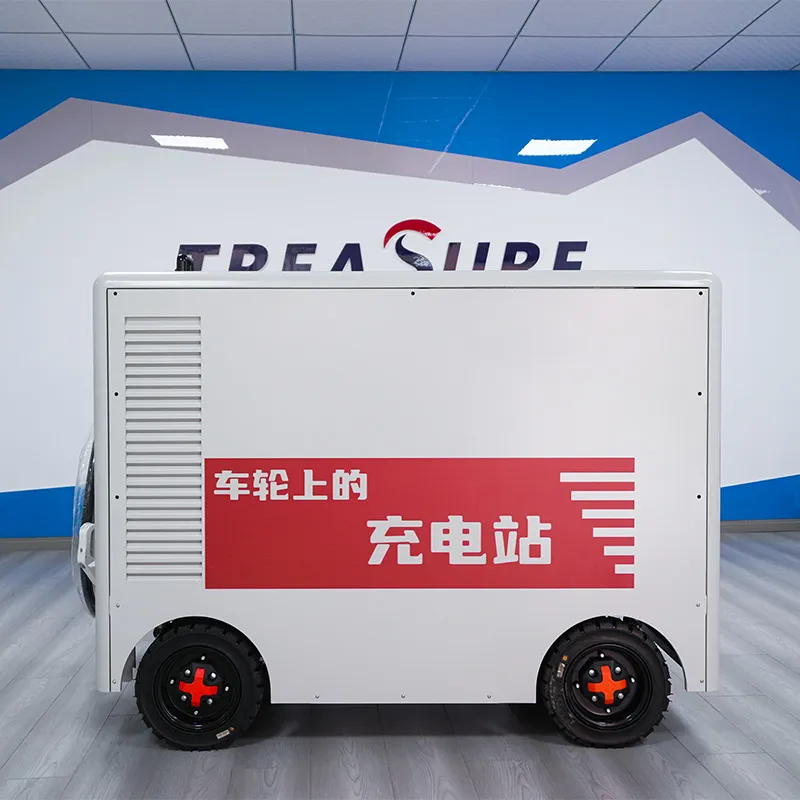
A 150kWh robô de carregamento móvel and a 200kWh unit share the same 314Ah cell architecture and 525.6–700.8V operating range, but they differ in disclosed weight (1.45t vs 1.9t) and — critically — in how charging power is documented. This matters more for fleet planning than the capacity number alone.
Mobile charging robots sit in an odd spot for spec research. Vendors publish energy capacity prominently because it’s the easiest number to market, then treat charging power, weight, and voltage architecture as secondary details buried in a spec sheet footnote or omitted entirely. For a depot operator trying to figure out whether a unit can turn around three vehicles in a shift, capacity alone doesn’t answer the question.
Where the 150kWh and 200kWh Tiers Fit in the Lineup
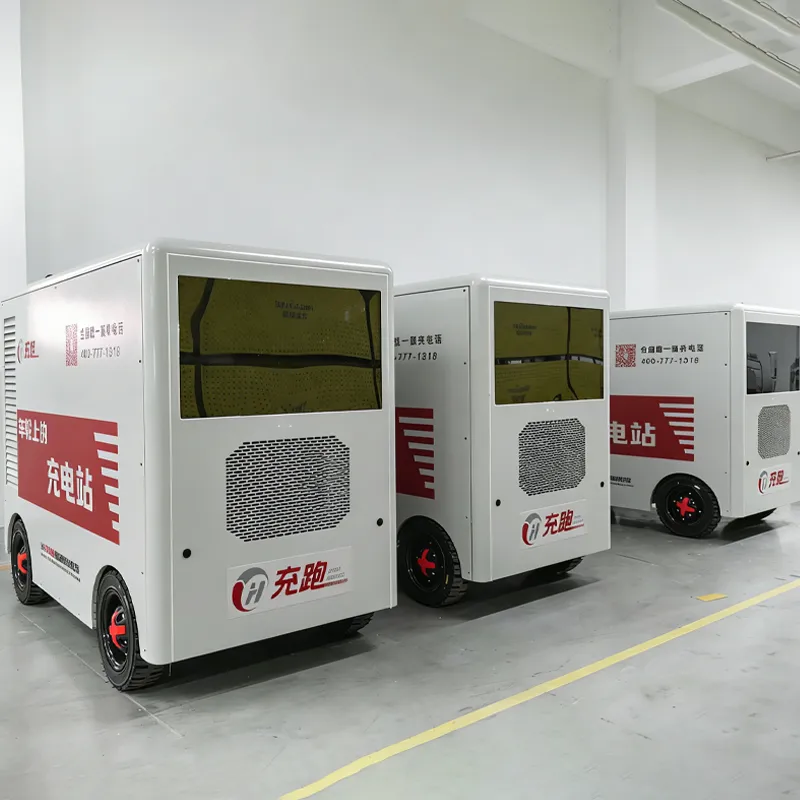
TREASURE’s mobile charging robot series is published across four energy tiers: 55kWh, 100kWh, 150kWh, and 200kWh. All four share the same cell chemistry and pack architecture — 314Ah cells operating across a 525.6–700.8V range — with charging power options listed separately at 40kW, 60kW, 80kW, and 120kW.
That’s the first thing worth flagging before comparing 150kWh and 200kWh directly: the four capacity tiers and the four power tiers are published as parallel lists, not as a locked one-to-one table. TREASURE’s own project documentation for two 2025 deployments identifies the 150kWh unit specifically as a 150kWh / 120kW configuration — the highest power rating in the published range paired with the second-highest capacity tier, not the top one. Whether the 200kWh unit ships at 120kW as well, or at a lower rating, is not confirmed in current public materials. Anyone specifying a 200kWh unit for a power-sensitive application needs to get that number in writing before ordering, not assume it scales with capacity.

Spec Comparison Across All Four Tiers
| Parâmetro |
55 kWh |
100 kWh |
150 kWh |
200 kWh |
| Approx. weight |
0.5 t |
0.9 t |
1.45 t |
1.9 t |
| Cell spec |
314 Ah |
314 Ah |
314 Ah |
314 Ah |
| Operating voltage range |
525.6–700.8 V |
525.6–700.8 V |
525.6–700.8 V |
525.6–700.8 V |
| Charging power (published range) |
40–120 kW options |
40–120 kW options |
Confirmed 120 kW in disclosed project configuration |
Not specified in current public materials |
| Connectors |
CCS, GB/T, project-configured |
CCS, GB/T, project-configured |
CCS, GB/T, project-configured |
CCS, GB/T, project-configured |
| Core electronics |
Integrated BMS, HMI, safety protection |
Same |
Same |
Same |
Weight is listed here in ascending order alongside the four capacity tiers as published, but TREASURE’s website doesn’t explicitly label which weight figure belongs to which kWh tier in a single table — the pairing above follows the ascending order both lists are presented in, and should be confirmed against a current datasheet before it goes into a procurement document. The 100kWh tier itself has a separate wrinkle: it shows up on the product detail page and homepage, but the category page’s primary lineup lists 55kWh, 150kWh, and 200kWh. If 100kWh isn’t part of the current commercial range, that changes which tier sits directly below 150kWh.
150kWh vs 200kWh: The Direct Comparison
| Parâmetro |
150 kWh Configuration |
200 kWh Configuration |
| Battery capacity |
150 kWh |
200 kWh |
| Approx. weight |
1.45 t |
1.9 t |
| Charging power |
120 kW (confirmed in published project configuration) |
Not publicly specified — confirm at quotation stage |
| Voltage range |
525.6–700.8 V |
525.6–700.8 V |
| Cell type |
314 Ah |
314 Ah |
| Best fit when… |
Power output per session matters as much as total energy on board — depots doing repeated fast turnarounds |
Total energy reserve matters more than peak output per session — longer standalone runs between recharges |
The weight difference (1.45t vs 1.9t) affects more than shipping cost. It determines what kind of tow vehicle or forklift a site needs to reposition the unit, and whether a facility’s floor loading and doorway clearances can handle it. That’s a site-survey question, not a spec-sheet afterthought, and it’s easy to skip when the conversation stays focused on kWh.
A Common Misreading: Bigger Capacity Doesn’t Automatically Mean More Power
The most frequent mistake in evaluating these tiers is assuming energy capacity and charging power scale together. They don’t have to. A 200kWh unit holds more total energy, but if its charging power output is the same as — or lower than — the 150kWh unit’s 120kW rating, it won’t recharge a vehicle any faster. It will simply support more charging sessions, or longer sessions, before it needs its own recharge.
For a depot running short, frequent top-up sessions, the 150kWh/120kW pairing may deliver more usable throughput per day than a 200kWh unit with a lower power ceiling. For an operator running one long deployment far from grid access — a remote site, an event, a disaster-response deployment — the extra 50kWh of onboard capacity in the 200kWh tier matters more than peak power. These are different buying decisions, and the capacity number alone doesn’t tell you which one you’re making.
Compared with many 150kW-class mobile charger listings that lead with headline power and output-voltage figures, Da TREASURE published configuration data makes it possible to separate the power rating from the capacity tier explicitly — most competing spec sheets bundle the two into a single “150kW mobile charger” label without breaking out which capacity tier that power figure applies to.
O que isto não lhe diz
The published material has real gaps that matter before you commit to a configuration:
- 200kWh charging power is unconfirmed. Unlike the 150kWh tier, which has a documented 120kW pairing from an actual deployed configuration, no public source confirms the charging power rating for the 200kWh unit. Request this in writing before specifying it for a power-dependent use case.
- Weight-to-capacity pairing is inferred, not labeled. The four weight figures (0.5t, 0.9t, 1.45t, 1.9t) and four capacity tiers appear in matching ascending order across separate parts of TREASURE’s published materials, but no single table ties them together explicitly.
- The 100kWh tier’s commercial status is unclear, which affects whether 150kWh sits second or third in the official lineup.
- No IP protection rating is published for the mobile charging robot series itself. IP ratings appear elsewhere in TREASURE’s product range (for example IP44 on the portable DC charger line, following the enclosure-rating framework defined by IEC 60529), but the robot series’ own ingress-protection figure isn’t listed in current public materials — confirm it directly for outdoor or wash-down environments.
- Certification status is unverified. No CE, UL, or other product certification for either tier should be assumed from public site content alone; certificate numbers and validity periods need direct confirmation.
Connector and Integration Notes
Both tiers ship with CCS and GB/T connector support, with additional project-configured interface options available. Core electronics are shared across the series: integrated BMS, mobile chassis, an operator HMI, standard safety protection, and optional remote monitoring. OEM and ODM configuration is available on both tiers, which matters for fleet operators running a mixed connector standard across regions — CCS and GB/T interoperability follows the architecture frameworks maintained by CharIN for CCS-based charging systems.
Preços
Neither the 150kWh nor the 200kWh configuration has a published price range. Final quotation depends on the selected charging power, voltage architecture, connector standard, BMS configuration, enclosure requirements, and OEM/ODM scope — all of which shift meaningfully between a 120kW unit and whatever power rating the 200kWh tier ships at. Submitting the target use case, required power and energy capacity, and site conditions is the fastest way to get a project-specific number.
FAQ
Q: Is the 200kWh mobile charging robot rated for the same 120kW charging power as the 150kWh unit?
A: This isn’t confirmed in current public materials. The 150kWh tier has a documented 120kW configuration from an actual deployment; the 200kWh tier’s power rating needs to be confirmed directly before ordering.
Q: Can either tier charge multiple vehicles at once?
A: Public materials for the mobile charging robot series don’t specify simultaneous multi-vehicle charging for the 150kWh or 200kWh tiers specifically (that capability is documented elsewhere in TREASURE’s mobile power lineup, for a different product). Confirm session configuration directly for these two tiers.
Q: What connector types do these units support?
A: Both tiers list CCS and GB/T as standard, with additional project-configured interface options available depending on the target market.
Q: How much does a 150kWh or 200kWh mobile charging robot cost?
A: Pricing isn’t published for either tier. It’s set per project based on charging power, voltage architecture, connector standard, BMS/EMS requirements, and OEM/ODM scope — request a quotation with your use case and site details for an accurate figure.

 Robôs Móveis de Carregamento de VE
 Fonte de Alimentação de Emergência Montada em Veículo
 Sistemas de Armazenamento de Energia
 Catálogo de Carregadores DC de VE
 Equipamento de Carregamento V2V DC