TREASURE Technical Team | Corporate Technical Author — Battery Energy Storage and EV Charging Systems | Published September 14, 2026
A sạc điện thoại di động unit for an EV fleet is a battery-storage charger that recharges from the grid off-peak, then discharges on demand at the depot, bus relay point, or remote site without a live grid connection at point of use. For depot operators, it solves a scheduling problem — not a power-generation one.
Fleet Charging Has a Different Problem Than Parking-Lot Charging
Most coverage of các robot sạc di động is written for drivers looking for convenience in a mall parking garage. That’s not the operator problem. A depot manager isn’t choosing between a fixed spot and a robot that comes to them — they’re managing a fleet on a schedule, with vehicles that need to be back on the road within a defined window, at a site where the grid connection may not support enough simultaneous fixed chargers to hit that window.
Three fleet-specific scenarios come up repeatedly: relay charging for buses running fixed routes, mining or remote-site operations with no practical grid access at all, and shift-change overflow at depots where fixed infrastructure covers average load but not the peak when an entire shift returns at once.
Relay Charging: How It Actually Works
Relay charging means a mobile unit meets a vehicle mid-route or at a turnaround point, rather than the vehicle returning to a central depot to charge. For bus operators running fixed routes, this changes route planning more than it changes the charger itself.
- Identify low-dwell-time points on the route — terminus stops or layovers where a bus sits for 10–20 minutes anyway.
- Position the mobile unit at that point, pre-charged during the vehicle’s earlier off-peak hours.
- Top up the bus during its scheduled dwell time, rather than routing it back to a depot charger.
- Return the mobile unit for its own recharge cycle once the route’s relay window closes, scheduled against the next day’s dwell pattern.
This only works if the mobile unit’s own recharge scheduling is treated as a constraint on the route, not an afterthought. A unit that’s still depleted from the morning relay won’t be ready for an afternoon shift without deliberate scheduling around both vehicle and charger.
Mining and Remote-Site Fleets: A Different Deployment Profile
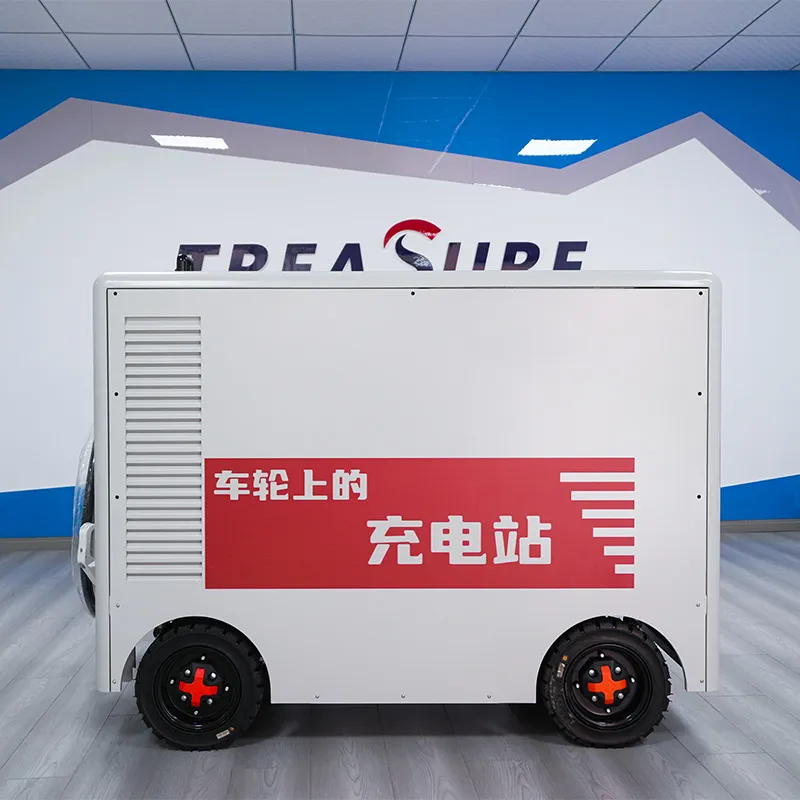
Mining sites and other remote operations face a simpler but harder constraint: there often isn’t a grid connection to build fixed infrastructure around at all. Mobile charging units here function less as overflow capacity and more as the primary charging method, recharged during equipment downtime or from an on-site generator and dispatched to vehicles across the site as needed.
The planning question shifts from “how do we supplement fixed chargers” to “how many mobile units does our vehicle count and shift pattern require, and how do we keep their own recharge cycles from colliding with peak dispatch demand.” That’s a fleet-sizing exercise specific to vehicle count, route length, and duty cycle — not something a generic spec sheet answers.
Core Specifications for Fleet Procurement
TREASURE’s Mobile EV Charging Robot Series publishes the following parameters — treat this as a reference point for evaluating any vendor’s lineup against your fleet’s power and duty-cycle needs, not a universal industry standard.
| Thông số |
Disclosed Range |
| Dung lượng năng lượng |
55 kWh, 100 kWh, 150 kWh, 200 kWh |
| Charging power output |
40 kW, 60 kW, 80 kW, 120 kW |
| Thông số kỹ thuật của tế bào pin |
314 Ah |
| Dải điện áp hoạt động |
525,6–700,8 V |
| Approximate unit weight |
0.5 t / 0.9 t / 1.45 t / 1.9 t by capacity tier |
| Connector options |
CCS, GB/T, các giao diện được cấu hình theo dự án |
| Control |
Integrated BMS, HMI, optional remote monitoring |
| Tùy chỉnh |
Có sẵn tùy chọn cấu hình OEM/ODM |
Fleet buyers evaluating the 100 kWh tier specifically should note that TREASURE’s own site lists it inconsistently — present on the product-detail and homepage, absent from the main category listing — so confirm current commercial availability before sizing a fleet order around that capacity.
Adding a Mobile Unit vs. Two Other Options
| Approach |
Grid upgrade required |
Lead time |
Handles peak-only demand efficiently |
| Add fixed depot chargers sized to average load |
Possibly, depending on capacity |
Weeks to months |
No — underbuilt for peaks |
| Upgrade grid connection, add fixed chargers sized to peak |
Yes, always |
Months, permitting-dependent |
Yes, but idle most of the day |
| Add mobile charging units for peak coverage |
No |
Days once delivered |
Yes — capacity matches when it’s needed |
A depot that oversizes fixed infrastructure to cover a shift-change peak is paying for capacity that sits unused the rest of the day. A mobile unit shifts that cost to a smaller number of units that cover the peak and can be scheduled elsewhere — or simply parked and recharged — the rest of the time.
The Scheduling Mistake Fleet Operators Make
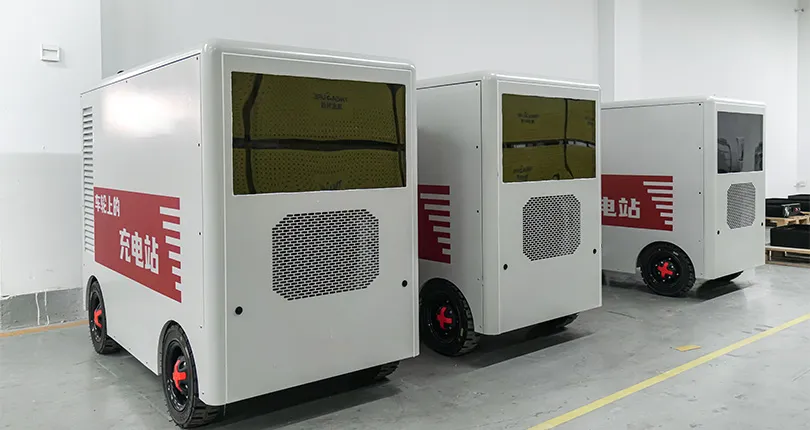
The most common error isn’t choosing the wrong unit — it’s treating a mobile charger’s own recharge cycle as infinite. A 150 kWh unit delivering 120 kW discharges for roughly an hour of sustained output before it needs recharging itself. If a depot dispatches its only mobile unit to cover a morning shift-change and expects it available again for an evening peak without a scheduled recharge window in between, it won’t be there when needed. Route and shift planning for mobile charging capacity has to account for the charger’s duty cycle the same way it accounts for a vehicle’s.
Procurement and Costs
No flat pricing is published for this equipment category — TREASURE included — because the final cost depends on fleet-specific variables: energy capacity, charging power, voltage architecture, connector standard, battery configuration, BMS/EMS specification, and OEM/ODM requirements. Fleet operators should expect a project-specific quotation process built around vehicle count, route or site layout, and grid conditions rather than a catalog price. CHAdeMO Association and CharIN both publish connector and communication standards worth checking against your fleet’s existing vehicle mix before specifying connector requirements in an RFP.
Câu hỏi thường gặp
Q: How many mobile charging units does a bus depot need for relay charging?
A: This depends on route length, dwell time at relay points, and how many buses need charging within the same window — there’s no fixed ratio. Sizing requires mapping your route schedule against a specific unit’s discharge duration and recharge time.
Q: Can mobile charging units replace fixed depot infrastructure entirely?
A: For most depots, no. Mobile units work best covering peak or relay demand alongside base fixed infrastructure sized to average load, since their onboard battery capacity limits continuous duty cycle in a way grid-connected chargers don’t face.
Q: What connector types work for fleet vehicles?
A: TREASURE’s Robot sạc xe điện di động Series supports CCS and GB/T as standard, with project-configured interfaces available. Confirm compatibility against your specific fleet’s vehicle mix and target market standards before ordering.
Q: Is mobile charging cost-effective for mining or remote-site fleets?
A: Cost-effectiveness depends on the alternative — grid extension to a remote site is often far more expensive and slower than deploying mobile units, but the comparison is project-specific. TREASURE provides project-by-project quotations based on vehicle count, site layout, and duty cycle rather than a flat price.

 Robot sạc EV di động
 Nguồn điện khẩn cấp gắn trên xe
 Hệ thống lưu trữ năng lượng
 Danh mục bộ sạc EV DC
 Thiết bị sạc DC V2V