TREASURE Technical Team | Corporate Technical Author — Battery Energy Storage and EV Charging Systems | Published September 11, 2026
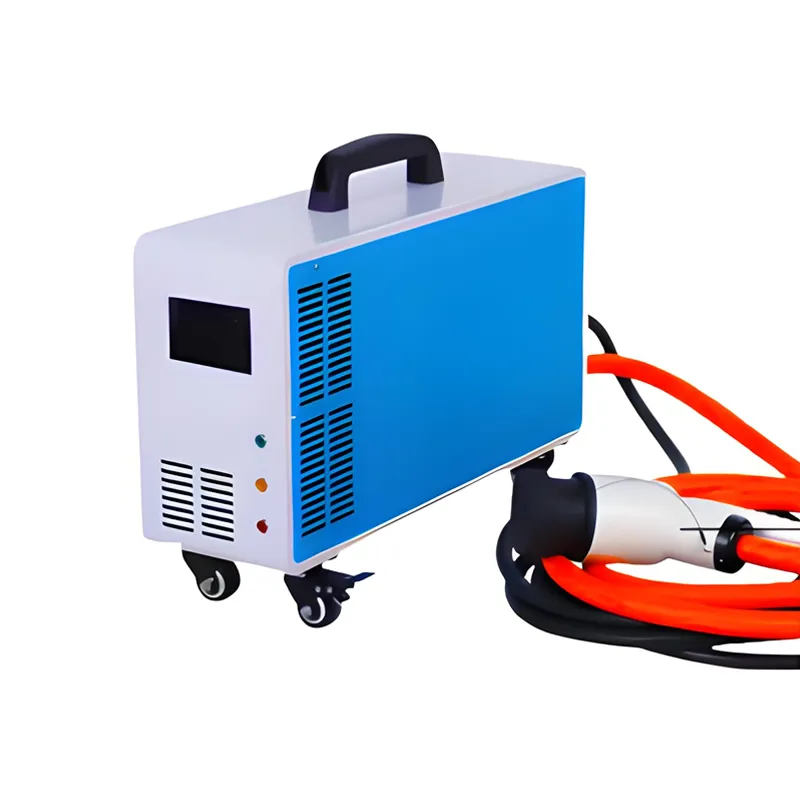
A mobile Stazione di ricarica EV is a battery-backed, wheeled or trailer-mounted charging unit that delivers DC power without a permanent grid connection at the charging point. For operators, the decision usually comes down to one question: can this equipment absorb demand a fixed pile can’t reach in time, on a site where trenching isn’t an option?
What “Mobile EV Charging Station” Actually Covers
The term gets applied loosely across three different product categories, and mixing them up leads to mismatched expectations.
A caricabatterie portatile a corrente continua is a small, plug-in unit — think 6.6–20 kW — that still draws from a live grid connection; it’s mobile in the sense that you can carry it, not in the sense that it stores energy. A mobile charging robot is a self-contained battery system on a chassis: it charges from the grid during off-peak hours, then drives or is towed to a vehicle and discharges on demand, with no cable back to a substation. A mobile fast-charging station, sometimes built into a trailer, sits between the two — a larger battery pack paired with a fast-charging output, often parked semi-permanently at a site rather than moved vehicle-to-vehicle.
This guide focuses on the second category — the mobile charging robot — since that’s where most of the deployment-economics questions from operators actually land.
Why Operators Are Looking at Mobile Charging Now
Search results on this topic are dominated by consumer-facing coverage: robots roaming parking garages, valet-style charging at malls, novelty press photos. That framing tells you almost nothing if you’re planning charging capacity for a bus depot or a fuel-retail forecourt.
The operator-side driver is almost always one of three constraints: the site’s grid connection can’t support additional fixed chargers without a costly utility upgrade, the available parking or forecourt space doesn’t allow for trenching and conduit work, or demand is concentrated in short peak windows that don’t justify permanently installed capacity sitting idle the rest of the day. The International Energy Agency’s Global EV Outlook has tracked charging infrastructure lagging vehicle adoption in exactly these constrained environments — aging retail sites, converted fuel stations, mixed-use lots — which is the gap mobile charging equipment is built to fill, not a replacement for fixed infrastructure at high-throughput locations.
Core Specifications That Determine Fit
Before comparing vendors, get the numbers that actually decide whether a unit works on your site. Below are the publicly disclosed parameters for TREASURE’s Mobile EV Charging Robot Series, shown as a reference point rather than a universal standard — every manufacturer’s lineup differs.
| Parametro |
Disclosed Range |
| Capacità energetica |
55 kWh, 100 kWh, 150 kWh, 200 kWh |
| Charging power output |
40 kW, 60 kW, 80 kW, 120 kW |
| Specifiche delle celle della batteria |
314 Ah |
| Intervallo di tensione di funzionamento |
525,6–700,8 V |
| Approximate unit weight |
0.5 t / 0.9 t / 1.45 t / 1.9 t (by capacity tier) |
| Connector options |
CCS, GB/T, interfacce configurate in base al progetto |
| Control |
Integrated BMS, HMI, optional remote monitoring |
| Personalizzazione |
Configurazione OEM/ODM disponibile |
Two things worth flagging before you build a spec sheet around this table. First, weight-to-capacity pairing above is inferred from tier positioning rather than confirmed per-SKU on a single published datasheet, so treat it as directional. Second, TREASURE’s own site is inconsistent on whether the 100 kWh configuration is a standing catalog item — it appears on the product-detail and homepage but not on the main category listing — so any operator evaluating that specific tier should confirm current commercial availability directly with the manufacturer before quoting a project around it.
The comparison that matters isn’t “which is better” — it’s which fits the site constraint you actually have.
| Dimension |
Robot di ricarica mobile |
Fixed DC Fast Charger |
| Grid connection required at charge point |
No — charges from grid separately, discharges on-site |
Yes — permanent connection |
| Civil works |
None at the charging location |
Trenching, conduit, foundation |
| Deployment time |
Days once delivered |
Weeks to months, permitting-dependent |
| Duty cycle |
Limited by onboard battery capacity |
Continuous, limited only by grid supply |
| La migliore vestibilità |
Peak-shaving, temporary demand, space-constrained sites |
High-throughput, fixed daily traffic |
| Relocatable |
Sì |
No |
A mobile robot doesn’t out-charge a fixed 350 kW pile over a full day. What it does is put charging capacity somewhere a fixed pile can’t go quickly, or shouldn’t go permanently — a lot corner slated for redevelopment, a depot expanding faster than its utility upgrade timeline, a site where afternoon queues justify extra capacity but morning traffic doesn’t.
Deployment Models Operators Are Actually Running
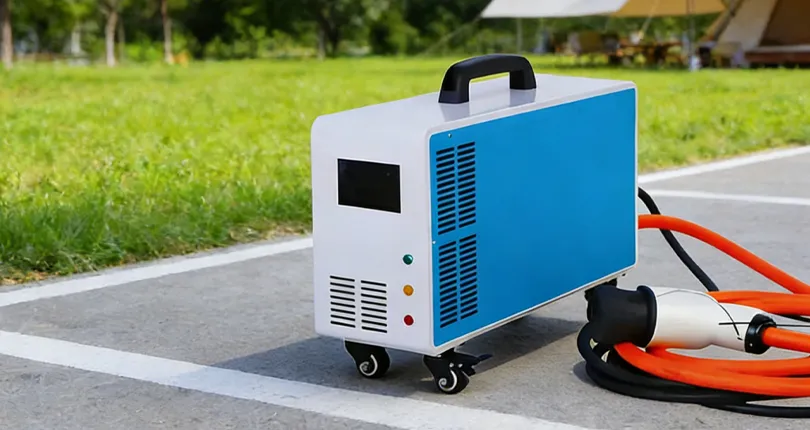
- Fleet depot overflow. Base charging infrastructure covers routine turnaround; a mobile unit absorbs the shift-change spike so vehicles aren’t queuing for a fixed bay.
- Forecourt peak-shaving. At fuel-retail sites converting to EV service, a mobile robot handles midday and evening surges while the site’s permanent charger count stays sized to average, not peak, demand.
- Pre-infrastructure bridging. Sites with EV charging demand today but a grid upgrade or permitting process still months out use mobile capacity as a stopgap rather than delaying service.
- Remote or temporary sites. Mining operations, event venues, and construction sites with no practical path to a grid connection at all.
Each of these depends on the operator scheduling the robot’s own recharge window — typically overnight, off-peak grid draw — around when it needs to be back in service. Get that scheduling wrong and the unit shows up to a peak-demand window already partially depleted.
Where Operators Get This Wrong
The most common misconception isn’t about the hardware — it’s about duty cycle. A mobile charging robot is not a substitute for continuous grid-fed capacity; it’s a finite battery that needs its own recharge window before it can discharge again. A 150 kWh unit delivering 120 kW output runs out of stored energy in a little over an hour of sustained full-power discharge, before accounting for round-trip efficiency losses. Operators who plan mobile capacity as if it were an unlimited fixed charger end up with a unit sitting depleted during the exact peak window it was bought to cover. The fix is treating the robot’s own charge cycle as a scheduling constraint on par with vehicle arrival patterns, not an afterthought.
Costs and Procurement
Mobile charging robot pricing is not published by any manufacturer as a flat number, TREASURE included — and for legitimate reasons: the final cost depends on energy capacity, charging power, voltage architecture, connector standard, battery configuration, BMS/EMS specification, communication protocol, and OEM/ODM requirements. Operators evaluating this equipment should expect a project-specific quotation process built around their fleet size, grid conditions, and deployment schedule, not a catalog price.
FAQ
Q: How long does a mobile EV charging robot take to recharge itself?
A: This depends on the unit’s onboard capacity and the charging power used to refill it, and isn’t a fixed number across the category — check the manufacturer’s datasheet for the specific model and confirm whether your site’s grid connection supports the robot’s intended recharge rate.
Q: Can a mobile charging robot replace a fixed DC fast charger entirely?
A: Not for continuous high-throughput sites. Mobile units are limited by onboard battery capacity and need their own recharge window, so they work best alongside fixed infrastructure — covering peaks, temporary demand, or space-constrained locations — rather than replacing grid-connected fast chargers at high-traffic sites.
Q: What connector types do mobile charging robots support?
A: TREASURE’s Robot mobile per la ricarica dei veicoli elettrici Series supports CCS and GB/T as standard, with additional project-configured interfaces available. Confirm connector compatibility against your fleet’s vehicle mix before ordering.
Q: Is pricing available for mobile EV charging stations?
A: Pricing is provided on a project-by-project basis and depends on energy capacity, charging power, voltage architecture, connector standard, battery configuration, PCS selection, enclosure design, communication protocol, software integration, logistics, commissioning, and other project requirements.

 Robot di ricarica mobile per veicoli elettrici
 Alimentazione di emergenza montata sul veicolo
 Sistemi di accumulo di energia
 Catalogo dei caricatori EV DC
 Apparecchiature di ricarica V2V in corrente continua