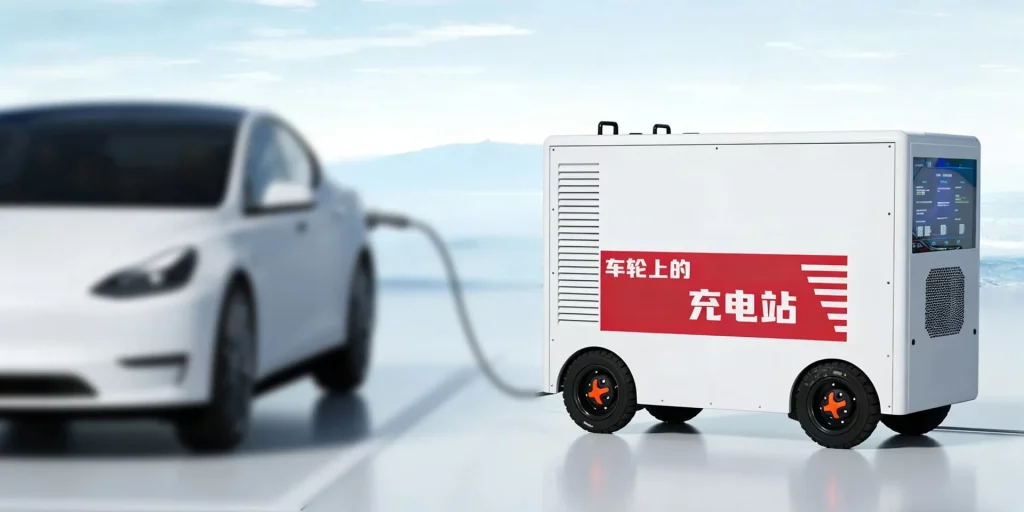
On-demand EV charging sends a mobile charging unit to a vehicle instead of routing the vehicle to a fixed charger. The process runs through three stages — a charging request, dispatch of a unit to the vehicle’s location, and an on-site charging session — coordinated through a dispatch or fleet-management platform rather than a driver simply plugging into a stationary post.
What “On-Demand” Actually Changes About Charging
Fixed charging infrastructure ties a charging event to a location. A driver finds an available post, parks near it, and waits for their turn if it’s occupied. On-demand charging decouples the charging event from the post: the charger comes to the vehicle’s parking spot, and the constraint shifts from “is a post free” to “is a mobile unit available and dispatched in time.”
That shift matters for site operators more than for drivers. A driver experiences on-demand charging as a booking flow. An operator experiences it as a fleet-management problem: how many units does a site need, how are they routed, how is battery state tracked between charging sessions, and how does the charging equipment report back to whatever platform is running the site. Most public coverage of on-demand charging robots addresses the first question. This piece addresses the second.
The Three Stages Between a Request and a Charged Battery
Every on-demand charging deployment resolves into the same three operational stages, whether the request originates from a driver’s app, a facility’s internal booking system, or an automated queue triggered by a parked vehicle’s telematics.
- Request. A charging need is registered — by a driver, a fleet dispatcher, or an automated trigger — and logged against a specific vehicle location and, usually, a target state of charge or time window.
- Dispatch. A charging unit is assigned to the request and moved to the vehicle. This is where fleet-sizing, unit availability, and routing logic determine whether the request is served immediately or queued.
- Charging session. The unit connects, authenticates the session, delivers power at its rated output, and reports session data — energy delivered, duration, and any fault conditions — back to whichever platform is managing the site.
The third stage is the one most consumer-facing coverage treats as the whole story: plug in, charge, done. For an operator, stages one and two are where the actual planning problem sits, because they determine fleet size, queue depth during peak demand, and how much of the site’s charging capacity sits idle between requests.
Why the Dispatch Layer Matters More Than the Robot
A robô de carregamento móvel is a battery on wheels with a connector. What makes it useful at a specific site is the software layer coordinating requests, tracking each unit’s remaining charge, and deciding which unit answers which request. Compared to consumer-facing on-demand charging robots that route every booking through a single branded app, an operator deployment typically needs the dispatch logic to plug into whatever platform the site already runs — a parking operator’s existing app, a depot’s fleet-management system, or a fuel-retail chain’s point-of-sale and loyalty software.
This is the integration point that determines whether on-demand charging works at a given site. A unit with strong hardware specifications but no path into the operator’s existing software still requires a driver, attendant, or dispatcher to coordinate requests manually, which erodes most of the labor and throughput advantage the model is supposed to provide.

Mobile EV Charging Robot Series: The Hardware Behind the Dispatch
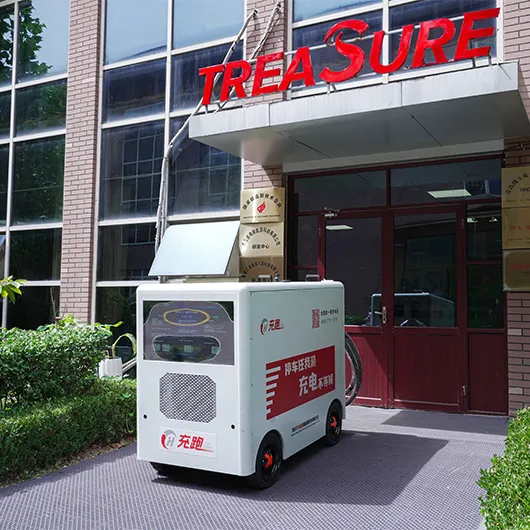
The dispatch process above assumes a charging unit capable of independent operation, remote status reporting, and connector flexibility across different vehicle types. TREASURE’s Mobile EV Charging Robot Series is built around those requirements. Publicly disclosed specifications for the series are summarized below.
| Parâmetro |
Disclosed Value |
| Energy Capacity Options |
55 kWh, 100 kWh, 150 kWh, 200 kWh |
| Charging Power Options |
40 kW, 60 kW, 80 kW, 120 kW |
| Battery Cell Specification |
314 Ah |
| Operating Voltage Range |
525.6–700.8 V |
| Approximate Weight (by Capacity Tier) |
0,5 t / 0,9 t / 1,45 t / 1,9 t |
| Connector Options |
CCS, GB/T, and other project-configured interfaces |
| Onboard Systems |
Integrated BMS, mobile chassis, HMI, and safety protection |
| Remote Monitoring |
Optional |
| Configuration |
OEM and ODM available |
Two things in this table need a caveat before they go into a formal quotation. First, the 100 kWh configuration appears on the product-detail page and homepage, while the category listing centers on 55 kWh, 150 kWh, and 200 kWh — the current commercial lineup should be confirmed with TESOURO directly rather than assumed from either page alone. Second, connector support is listed as CCS, GB/T, or “other project-configured interfaces,” which means the connector set is not fixed across every unit; it’s specified per project, and an operator serving a mixed fleet (CCS and GB/T vehicles at the same site, for example) needs to confirm connector configuration before ordering rather than after.
The “mobile chassis” description does not, by itself, confirm autonomous navigation. Operators evaluating this category against self-navigating consumer robots should treat driving and positioning method as a separate question to raise directly, not an assumption to carry over from other products in the category.
Where the On-Demand Model Still Breaks Down
On-demand charging solves a real infrastructure-access problem, but three operational limits are worth naming plainly rather than glossing over.
A mobile unit still needs to recharge itself. Decoupling the charging point from a fixed location doesn’t remove the grid connection — it moves it to wherever the fleet of units recharges between dispatch cycles, and that recharging schedule has to be planned around peak-demand windows the same way any battery system does.
Fleet size sets a hard ceiling on how “on-demand” the service actually feels. A single unit can only be in one place at a time; if request volume during a peak window exceeds available units, drivers queue, which is the exact wait time the model is meant to avoid. Sizing the fleet against realistic peak demand, not average demand, is the difference between a service that feels instant and one that doesn’t.
And connector mismatch is an ordering-time decision, not a site-time fix. Because interfaces are configured per project rather than shipped as one universal standard, a site that later expands to a new vehicle type may need additional units rather than a software update.
FAQ
What happens if no charging unit is available when a request comes in?
Queue behavior during peak demand is a fleet-sizing and dispatch-logic question specific to each deployment, not a fixed behavior published for the Mobile EV Charging Robot Series. Operators should plan unit count against expected peak concurrent requests, not average demand, before finalizing a site design.
Which connector standards does the Mobile EV Charging Robot Series support?
CCS and GB/T are listed, along with other project-configured interfaces. Because the connector set is specified per project rather than fixed across all units, sites serving mixed vehicle fleets should confirm the exact interface configuration before ordering.
How much does an on-demand mobile charging robot cost?
Pricing is provided on a project-by-project basis and depends on energy capacity, charging power, voltage architecture, connector standard, battery configuration, PCS selection, enclosure design, communication protocol, software integration, logistics, commissioning, and other project requirements.
Is this equipment certified for public-site deployment?
Certification status is not publicly verifiable from TREASURE’s current published materials, so no specific certification should be assumed for any configuration. Confirm applicable certificates, their numbers, and covered models directly before deployment.

 Robôs Móveis de Carregamento de VE
 Fonte de Alimentação de Emergência Montada em Veículo
 Sistemas de Armazenamento de Energia
 Catálogo de Carregadores DC de VE
 Equipamento de Carregamento V2V DC