TREASURE Technical Team | Battery Management Systems & Power Electronics | Published July 16, 2026
A portable DC charger’s rated power tells you speed. It doesn’t tell you whether the unit will actually run on the grid connection you have, or which EVs its output range can reach. That’s the gap most spec sheets leave open.
Why Power Rating Alone Doesn’t Answer the Question
Search “portable dc ev charger” and most results lead with kW numbers — 7kW, 20kW, sometimes a wall-mounted 40kW unit thrown into the same comparison. Power rating matters, but it’s not the variable that determines whether a unit works in your deployment. Input voltage range and output voltage ceiling do that job, and they’re the two specs buyers skip past most often.
Here’s the misconception worth correcting directly: a higher kW rating doesn’t automatically mean a charger reaches more vehicles. A 20kW unit built for a 265–475V input and a 1000V output ceiling is answering a completely different deployment question than a 6.6kW unit built for a standard 90–265V single-phase supply. One is designed to plug into ordinary grid power in the field; the other assumes access to a higher-voltage source already.
The Three Models, Side by Side
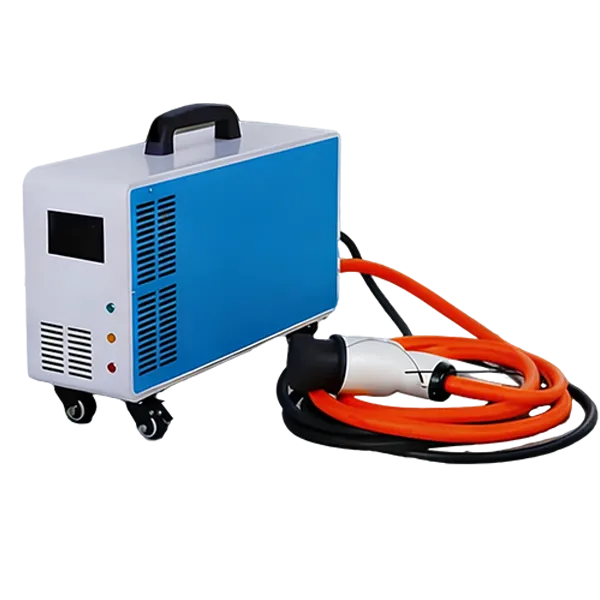
TREASURE’s national-standard portable DC charger line covers three configurations, each named for its power rating and maximum output voltage.
| Model |
Rated Power |
Input Voltage Range |
Max Output Voltage |
Koruma Derecesi |
| 6.6KW265V |
6.6 kW |
90–265 V |
265 V |
IP44 |
| 7KW750V |
7 kW |
90–280 V |
750 V |
IP44 |
| 20KW1000V |
20 kW |
265–475 V |
1000 V |
IP44 |
Three things stand out once you read past the power column:
- The 6.6KW265V and 7KW750V models both accept a similar low input range (roughly 90–280V), but their output ceilings are worlds apart — 265V versus 750V. That means the 7KW750V can reach a meaningfully wider band of EV battery architectures even though its power output is barely higher.
- The 20KW1000V model needs a 265–475V input to begin with. It’s not a drop-in replacement for the other two in a location that only has standard low-voltage supply — it assumes a different electrical starting point.
- All three share the same IP44 protection rating, which is worth understanding rather than assuming. Per IEC 60529, the international standard for ingress protection ratings, IP44 protects against solid objects larger than 1mm and splashing water from any direction — adequate for many outdoor deployments, but not the same as a fully submersible or high-pressure washdown rating. If your deployment involves heavy rain exposure or pressure cleaning near the unit, confirm this rating covers your actual site conditions before ordering, since an IP rating on a datasheet applies only to the tested configuration, not automatically to every mounting scenario.
Where Each Model Actually Fits
The 6.6KW265V suits low-power, standard-outlet deployments — light-duty fleet top-ups or roadside assistance where a full DC fast-charge isn’t the goal, just enough charge to get a vehicle moving again.
The 7KW750V is the middle option: similar input requirements to the 6.6kW unit, but its 750V output ceiling reaches a wider range of EV pack voltages. For operators supporting mixed fleets without knowing every vehicle’s battery architecture in advance, this gap matters more than the 0.4kW power difference suggests.
The 20KW1000V is built for faster charging where a higher-voltage input source is already available — depot charging, service centers, or fixed installations with upgraded electrical capacity, rather than a van pulling up to a standard wall outlet.
What This Doesn’t Tell You
None of the three models’ datasheets specify exact charge-time-to-percentage figures, since actual charge time depends on the receiving vehicle’s battery capacity, state of charge, and its own onboard charging curve — not just the charger’s rated output. Treat any charge-time claim from any supplier as configuration-specific, not a universal guarantee.
Pricing
Pricing is provided on a project-by-project basis and depends on energy capacity, charging power, voltage architecture, connector standard, battery configuration, PCS selection, enclosure design, communication protocol, software integration, logistics, commissioning, and other project requirements. Submit your target vehicle voltage range and deployment site conditions for a project-specific quotation.
SSS
Q: If I need to charge a wide range of EV models, which of these three should I choose?
A: Output voltage ceiling matters more than power rating for compatibility breadth. The 7KW750V reaches a wider voltage band than the 6.6KW265V despite a small power difference, while the 20KW1000V reaches further still but requires a higher-voltage input source to begin with.
Q: Does IP44 mean these units can be used outdoors in rain?
A: IP44 protects against splashing water from any direction per IEC 60529, which covers many outdoor use cases, but it isn’t a submersion or high-pressure-washdown rating. Confirm it matches your specific site’s exposure before deployment.
Q: Can the 20KW1000V run on a standard low-voltage outlet like the other two models?
A: No — it requires a 265–475V input, a different electrical starting point than the 6.6KW265V or 7KW750V’s roughly 90–280V range. Site electrical capacity needs to be confirmed before selecting this model.
Q: What does a portable DC charger cost?
A: Pricing is project-specific and depends on voltage architecture, connector standard, and other configuration factors — submit your requirements for a quotation.

 Mobil EV Şarj Robotları
 Araç Üzeri Acil Güç Kaynağı
 Enerji Depolama Sistemleri
 EV DC Şarj Cihazları Kataloğu
 Araçtan Araca DC Şarj Ekipmanı