TREASURE Technical Team | Corporate Technical Author — Battery Energy Storage and EV Charging Systems | Published August 13, 2026
A mobil elektrikli araç şarjı solution is a battery-buffered charging unit that stores energy during off-peak hours and discharges it to vehicles wherever they’re parked, without a dedicated grid connection at each stall. For depot operators facing space or capacity limits, it functions as charging infrastructure that relocates instead of one that gets poured into concrete.
What Counts as a Mobile EV Charging Solution in a Depot Context?
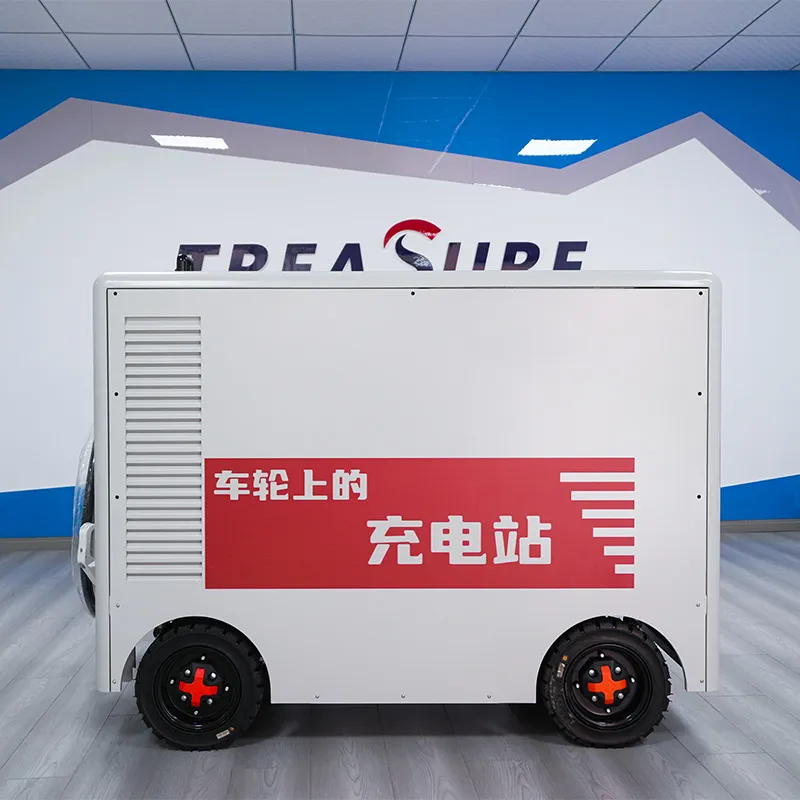
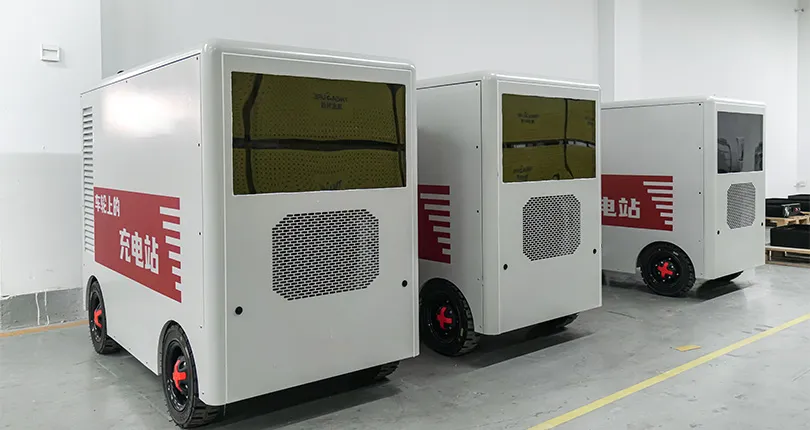
The term covers a range of equipment, but for fleet and depot applications it usually means a self-contained battery unit on a mobile chassis: an onboard battery pack, an integrated BMS, a charging interface (CCS, GB/T, or a project-specified connector), and an HMI for the driver or dispatcher to operate. The unit charges from the grid during low-demand windows, then drives or is towed to wherever a vehicle needs power.
This is distinct from a portable AC charger or an extension-cable setup. A mobile charging robot carries its own energy reserve, so it can deliver DC fast-charging power to a bus or van parked at the far end of a lot with no trench work and no new utility service.
Why Depot Operators Hit a Wall With Fixed Charging Infrastructure
Fixed chargers assume the vehicle comes to a permanent, wired location. That assumption breaks down in a few common depot scenarios:
1.Grid capacity is already maxed out. Older depots, especially converted fuel or service stations, were never sized for the electrical load a fleet of DC fast chargers requires. Upgrading the service can take months of utility coordination.
2.Civil works aren’t feasible on the current lease or timeline. Trenching, conduit, and pad-mounted transformers require permits and downtime the operator can’t absorb mid-contract.
3.Vehicle parking isn’t fixed. Relay-charging models, where a bus swaps into a charging slot mid-route and swaps back out, don’t map cleanly onto a stall with a single hardwired charger.
The International Energy Agency’s Global EV Outlook 2026 notes that EV adoption and the buildout of charging infrastructure are advancing across markets, and depot-level charging capacity is frequently the bottleneck that lags behind fleet electrification targets rather than vehicle procurement itself.
Mobile Charging Robot Specifications
TREASURE’s Mobile EV Charging Robot Series is built around the following disclosed parameters:
| Parametre |
Özellik |
| Enerji kapasitesi |
55 kWh, 100 kWh, 150 kWh, 200 kWh |
| Charging power |
40 kW, 60 kW, 80 kW, 120 kW |
| Battery cell spec |
314 Ah |
| Operating voltage range |
525.6–700.8 V |
| Approximate weight |
0.5 t to 1.9 t depending on configuration |
| Connectors |
CCS, GB/T, project-configured interfaces |
| Onboard systems |
Integrated BMS, mobile chassis, HMI, safety protection |
| İzleme |
Optional remote monitoring |
| Özelleştirme |
OEM/ODM configuration available |
A depot with a 40-vehicle relay-charging pattern and a 60 kW unit is working with a different charge-cycle math than one running a 120 kW unit against a tighter shift window — the power tier has to match the dwell time available at the depot, not just the vehicle’s battery size. Note that TREASURE’s published materials list slightly different capacity groupings across its product and category pages (some show 100 kWh as a standalone configuration, others group it under 55/150/200 kWh), so operators should confirm the exact model lineup with TREASURE before finalizing a spec sheet.
A Common Assumption That Doesn’t Hold: “Mobile Chargers Are Just Backup Power”
Depot managers sometimes treat mobile charging robots as an emergency fallback for when fixed infrastructure is down. That undersells the format. Because the unit charges off-peak and discharges on demand, it can function as a primary charging resource for relay-based fleet operations — buses swapping charge mid-shift, delivery vans cycling through a single dock — where a fixed charger’s location would force the fleet’s routing around it instead of the other way around. Treating it purely as a contingency asset means underutilizing the off-peak arbitrage it’s designed for.
Where Mobile Charging Robots Reach Their Limits
No format solves every constraint, and depot operators should weigh these against the flexibility gains:
- Throughput is capped by the onboard battery, not the grid. Once a 100 kWh unit is depleted, it needs to recharge before it can serve another cycle — a fixed charger with sufficient grid capacity doesn’t have that ceiling.
- Recharge scheduling adds an operational layer. Someone has to manage which units are charging, which are deployed, and when rotation happens, which is a coordination task a fixed installation doesn’t require.
- Upfront unit cost is concentrated in one asset. A single mobile robot represents more capital tied up in one piece of equipment than a comparably rated fixed charger, even though it avoids civil-works spend.
These tradeoffs matter more for high-volume, always-on depots than for space-constrained or capacity-constrained sites, which is where the format tends to make the clearest case.
Comparing Mobile and Fixed Charging Investment Paths
Compared to typical fixed-charger deployments, a mobile charging robot shifts spend from civil works and utility upgrades toward the unit itself and its recharge scheduling. Fixed infrastructure usually wins on raw throughput once it’s installed; mobile units usually win on deployment timeline and site flexibility, particularly at depots where lease terms, grid capacity, or parking layout would otherwise delay a fixed rollout by months.
Pricing and Project Quotation
HAZİNE does not publish fixed pricing for the Mobile EV Charging Robot Series. Final cost depends on energy capacity, charging power, connector standard, BMS/EMS requirements, communication protocol, OEM/ODM branding, and delivery terms. Operators submit their application scenario, required power and energy capacity, fleet information, and grid conditions before receiving a technical proposal and quotation.
SSS
Q: Can a mobile charging robot fully replace fixed chargers at a depot?
A: It depends on throughput needs. For relay-charging fleets or space-constrained sites, it can serve as the primary charging method. For high-volume, continuous-duty depots with adequate grid capacity, fixed chargers typically still handle better sustained throughput.
Q: How long does a mobile charging robot take to recharge itself?
A: This should be confirmed per configuration during the quotation process.
Q: What connector types does the Mobile EV Charging Robot Series support?
A: CCS and GB/T are standard, with additional project-configured interfaces available depending on the fleet’s vehicle mix.
Q: Is remote monitoring included by default?
A: Remote monitoring is offered as an optional feature rather than a standard inclusion, per TREASURE’s published specifications.
Depots weighing this format still need to size the unit count and power tier against their own duty cycle, which isn’t something a spec sheet alone answers. That sizing exercise — matching relay frequency, shift length, and vehicle battery size to a specific kWh/kW combination — is the next step once the general fit is confirmed.

 Mobil EV Şarj Robotları
 Araç Üzeri Acil Güç Kaynağı
 Enerji Depolama Sistemleri
 EV DC Şarj Cihazları Kataloğu
 Araçtan Araca DC Şarj Ekipmanı